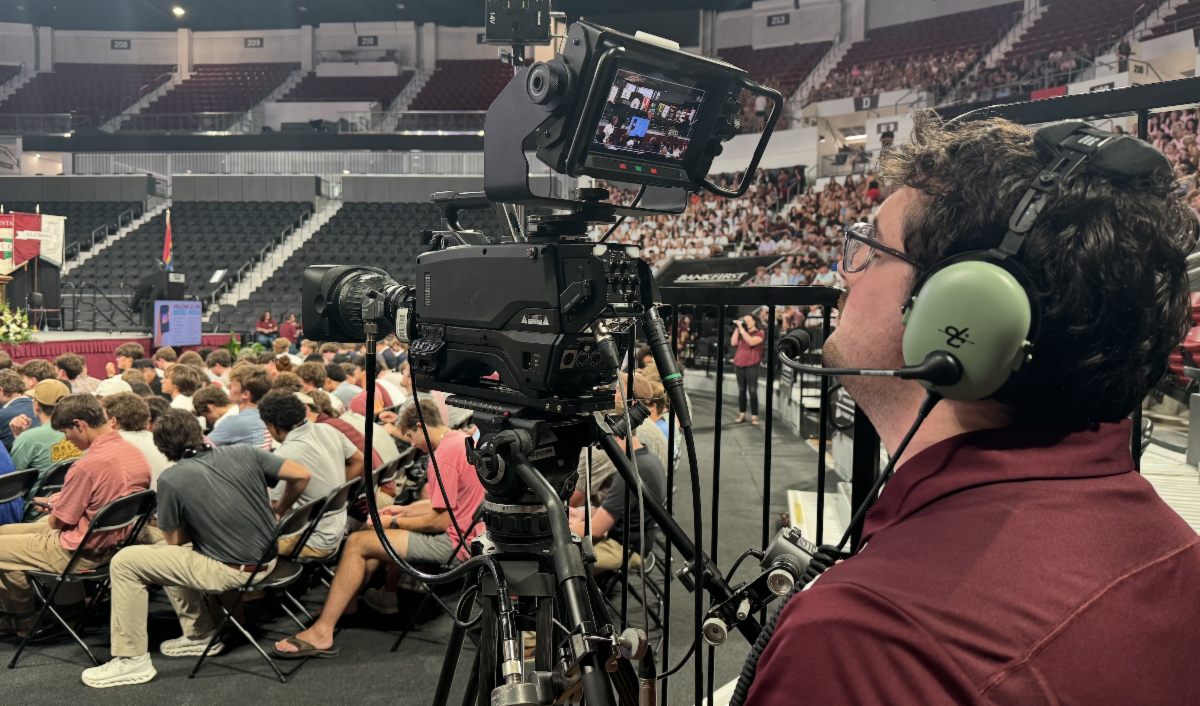
For nearly two decades, it has enjoyed a camera technology relationship with the company that recently changed its name to Kokusai Denki. Now, Mississippi State University is extending this partnership, as MSU’s University Television Center modernizes its live studio and field production workflows.
The center has purchased four SK-UHD7000-S2 cameras since 2024 and plans to add two more as funding allows, creating a six-camera complement split evenly between its studio and portable electronic field production systems.
The new cameras join two Kokusai Denki SK-HD1000 studio cameras that remain in full operation 17 years after their 2009 installation. The University Television Center is replacing those systems gradually as production technology advances.
The University Television Center manages MSU’s non-athletic broadcast television assets as part of the Division of Strategic Communications. Its 10-person professional staff produces live commencements and convocations, multi-camera outdoor concerts, parades, university events, interview programs and corporate-style meeting productions. Content is delivered through MSTV, a non-commercial cable channel available in more than 20 Mississippi cities, and a free 24-hour MSTV streaming app for mobile devices, Roku, Apple TV and other connected platforms.
“Our production requirements can change considerably from one project to the next,” said David Garraway, Director, University Television Center and Associate Director, Office of Public Affairs at Mississippi State University. “We may move from a concert or Christmas parade to a graduation, brand launch or annual meeting. The SK-UHD7000-S2 cameras give us the 1080p acquisition for streaming and video board productions, along with a software-upgradeable path to 4K as our infrastructure evolves.”
MSU purchased its first two SK-UHD7000-S2 cameras in summer 2024, followed by a third in spring 2025 and a fourth in Spring 2026. Three are assigned to a portable flypack, while one is currently installed alongside the SK-HD1000 cameras in the studio. The center operates its field cameras in 1080p and recently licensed the studio SK-UHD7000-S2 for 4K to test UHD workflows, identify infrastructure gaps and plan future upgrades before making a broader transition.
That phased strategy allows MSU to modernize production without making an immediate, facility-wide 4K investment. The SK-UHD7000-S2 is designed as a full-featured 1080p production camera and can be field-upgraded to native 4K/UHD operation through a software license. Its imaging architecture also helps the newer camera integrate visually with MSU’s existing systems, enabling operators to align the cameras for mixed-generation productions while realizing the added image detail of the current platform.
The University Television Center is also using the SK-UHD7000-S2’s SDI and Ethernet trunking capabilities to simplify field deployments. In one recent production, the team positioned a compact box camera next to an SK-UHD7000-S2 for a locked-off wide shot. By combining SDI and Ethernet trunking with accessory power from the SK-UHD7000-S2, MSU returned video, powered the secondary camera and maintained remote camera control over a single SMPTE fiber camera chain.
“That configuration gave us two camera positions with control from the remote control panel while requiring only one primary fiber run,” Garraway said. “It is a practical example of how we use the available camera functions to reduce the amount of infrastructure we need to deploy in the field.”
MSU’s field production model supports both self-contained and distributed workflows. The flypack houses its production switcher and camera control units in portable rolling racks that can operate in a ballroom support space or inside a Ford Transit production vehicle. For larger campus events, MSU uses its extensive single-mode fiber network to locate camera heads and control units at the venue while production personnel work from the Television Center control room up to 2.5 miles away. Ethernet connectivity between Kokusai Denki remote control panels and camera control units enables centralized shading and control, while SDI signals travel back to the studio.
“The ability to control the cameras over Ethernet has become an important part of our venue-to-control-room workflow,” Garraway said. “We can place the cameras and CCUs where the event is taking place, use the university fiber network for transport, and operate from our established control room across campus.”
The continued operation of MSU’s SK-HD1000 cameras provides a long-term benchmark for the center’s capital planning. The cameras have maintained consistent studio performance since their installation, and similar models used by MSU Athletics remain active in field production. For a public university responsible for careful stewardship of taxpayer funding, that service life helps inform how the Television Center evaluates technology investments and schedules replacements.
“Seventeen years later, the SK-HD1000 cameras are still part of our daily studio operation,” Garraway said. “Our migration plan is based on the progress of production technology and our future workflow requirements. As funding permits, we will add two more SK-UHD7000-S2 cameras and ultimately operate three in the studio and three in our field production systems.”
— Reporting by Brian Galante