
WASHINGTON, D.C. — On procedural grounds, the U.S. Supreme Court put the breaks on a decision from the U.S. Court of Appeals for the Fourth Circuit that would have prohibited anyone other than a political candidate from eligibility for the Lowest Unit Rate afforded by broadcast media when buying election-based advertising.
The decision, which became known late Friday ahead of the Labor Day holiday weekend, arrived just days after a three-judge Richmond federal appeals court panel ruled in favor of four Capitol Hill politicians who took the Federal Communications Commission to court in an effort to put a stop to a Public Notice they claim opens the door to what Democratic FCC Commissioner Anna M. Gómez calls “dark money spending” on political ads.
The case, National Republican Congressional Committee v. Sherrod Brown, Et. Al., arrived at the Supreme Court via an “application to stay” — a move designed to place a freeze on the 2-1 vote determining that candidate alone are entitled to the “lowest unit charge” for broadcast campaign advertisements in the run-up to elections.
This pleased Gómez, the lone Democrat on the Commission, and the plaintiffs — Brown, the former Ohio Senator and now Democratic nominee for U.S. Senate in Ohio seeking to fill Vice President J.D. Vance’s old seat; Georgia Democratic Senator Jon Ossoff; former North Carolina Governor and Democratic Senate Candidate Roy Cooper III; and Rep. Kristen McDonald Rivet (D-Mich.).
The statutory LUC requirement provides that during the 45-day period preceding a primary election and the 60-day period preceding a general election, “[t]he charges made for the use of any broadcasting station by any person who is a legally qualified candidate for any public office in connection with his campaign” must be at “the lowest unit charge of the station for the same class and amount of time for the same period.”
The biggest question: Are political parties and joint fundraising committees with non-candidate members entitled to the LUC? The FCC has asserted that they can, and a Public Notice issued by the Media Bureau on March 30, 2026, outlines this interpretation of the LUC.
How did the Fourth Circuit, led by 86-year-old Circuit Judge Robert Bruce King, rule? It granted the Federal Candidates’ Petition for Review and set aside “as unlawful and hold for naught” the Public Notice issued by the FCC’s Media Bureau.
That wasn’t acceptable to the Supreme Court.
“Because the candidates’ application for review was pending when they filed their petition for review, the Fourth Circuit likely lacked statutory jurisdiction to address their challenge,” the nation’s highest court ruled. “Its holding to the contrary splits with every other Circuit to have considered the issue.”
The NRC also argued that current and future recissions will require the party committees to pay more for advertising space, thereby hampering their efforts to reach the electorate in the critical weeks leading up to the midterms. “That injury,” the Supreme Court ruled, “cannot be remedied after the fact through refunds or reimbursements.”
Justice Kentanji Brown Jackson dissented, stating:
In my view, the applicants are not likely to succeed on the merits of their argument that the Fourth Circuit lacked statutory jurisdiction. See Brown v. FCC, ___ F. 4th ___, ___ (CA4 2026) (Wynn, J., concurring), App. 55 (concluding there is statutory jurisdiction on constructive-denial grounds because “an agency may not reserve to itself the power to defeat judicial review through delay or inaction”); see also Santos-Zacaria v. Garland, 598 U. S. 411, 417 (2023) (explaining that the Court “routinely” treats threshold requirements claimants must complete before filing a lawsuit as “nonjurisdictional” and has “yet to hold that any statutory exhaustion requirement is jurisdictional” (internal quotation marks omitted)).
Responding to the Supreme Court ruling on September 4, Gómez said the decision ”keeps in effect unofficial and unlawful FCC guidance that expands the lowest unit charge, the steep discount federal law requires for individual candidates buying campaign ads on TV and radio. Under this last-minute change, political parties and joint fundraising committees that pool money from multiple donors can now claim that same discount.”
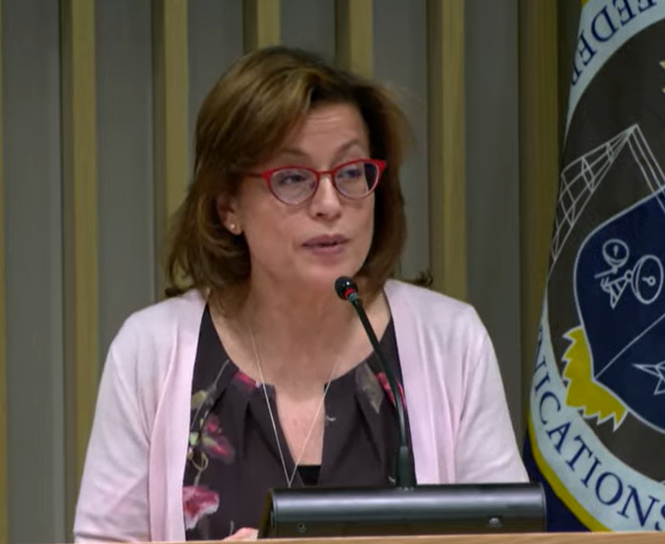 Furthermore, Gomez claims, “This stay throws the final stretch of the midterms into chaos. It lands on the very day discounts for campaign ads on TV and radio take effect, leaving broadcasters and campaigns scrambling with almost no time to prepare.”
She continued, “Just months ago, the Supreme Court lifted all limits on how much political parties can spend in direct coordination with candidates. Now that same money can also buy campaign ads at the lowest price the law requires broadcasters to charge only to individual candidates. That opens the door to a flood of dark money that will let a handful of wealthy donors pool unlimited contributions. Broadcasters are the ones absorbing the cost, many of them already struggling financially, and now they must sell more of their ad space at a steep discount right when they need this revenue the most. Ultimately, the ones who will be left to foot the bill are these local stations and the voters who depend on them for accurate information ahead of this election.”