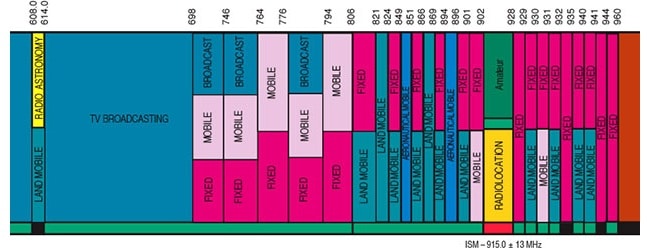
The International Telecommunications Union decided that the UHF spectrum will remain exclusively allocated to terrestrial TV services in Region 1 well into the next decade.
The action settles disputes over that spectrum between wireless services and broadcasters over its future use and has business implications in this country as well.
Representatives at the World Radio Conference decided that the 470-694 MHz band, which is also used by radio mics in addition to TV, will not change use now or at the next WRC meeting in 4 years. Instead, the spectrum will be reviewed again in 2023.
The issue got heated last week and both representatives from the wireless industry and the North American Broadcasters Association accused the other of spreading mis-information on the issue, we reported. The GSM Association, lobbying for the mobile industry at WRC, highlighted the 470 – 694 MHz band’s potential for rural mobile broadband deployments while NABA lobbied in favor of keeping the band for terrestrial television use.
EBU’s Simon Fell said the “millions” of viewers who rely on DTT to watch TV welcome the news. “Now that we have certainty on access to spectrum, the broadcasting industry can complete the transition to fully digital television broadcasting. We can also continue to innovate, and ensure that everyone has access to the benefits that new digital services bring.”
NAB, too was pleased with the outcome. NAB EVP Communications Dennis Wharton notes that of the 162 nations attending the conference, 140 “rejected the wireless broadband industry’s anti-broadcasting UHF spectrum grab and recognized that frequency band is harmonized to provide television services on a worldwide scale.”
The consensus, he said, should send a message that while wireless broadband services are important for those who can afford them, the service “should not come at the expense of a ubiquitous over-the air TV service that is available to all for free.”
ITU Region 1 comprises Europe, Africa, the Middle East (west of the Persian Gulf), and the whole of the territory of Armenia, Azerbaijan, the Russian Federation, Georgia, Kazakhstan, Mongolia, Uzbekistan, Kyrgyzstan, Tajikistan, Turkmenistan, Turkey, and Ukraine.
RBR+TVBR: The EBU hopes the decision will unite the European Union on this issue since there has been investment in DTT platforms, and that this decision will provide regulatory certainty to spur further investment and continue the use of DTT until at least 2030. To me, the key takeaway is the decision could have implications for U.S. executives whose companies have overseas broadcast investments as part of their portfolio.