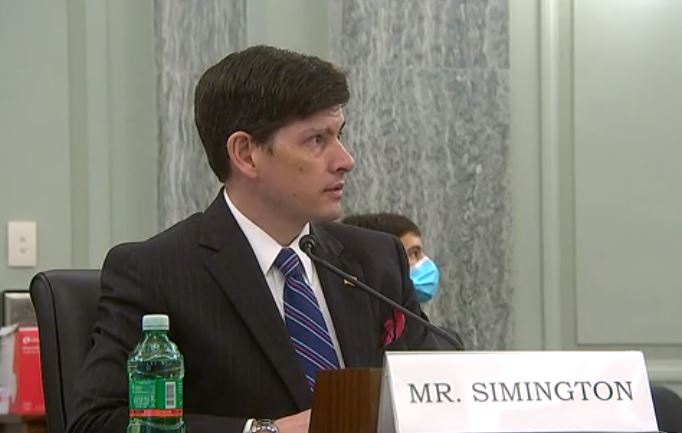
As RBR+TVBR first shared on its Twitter feed on Tuesday afternoon, the Republican majority of the U.S. Senate, by a 49-46 vote, confirmed Nathan Simington to be a member of the FCC.
Simington will take his seat as a Commissioner, replacing Mike O’Rielly, with the transition in power at the White House from President Trump to Joe Biden. Concurrently, FCC Chairman Ajit Pai will step down, as is traditional with a change in leadership at 1600 Pennsylvania Ave. N.W.
Much discussion is being had across Washington about a “deadlock” at the FCC come January 21, 2021. But, is that just conjecture?

Perhaps, but the prospect of a 2-2 deadlock, given the Republican support of a FCC Commissioner nominee who is adamant on erasing Section 230 of the Communications Decency Act — something O’Rielly, a strict constitutionalist, was unwilling to consider.
With President Trump reluctantly leaving the White House while refusing to concede an election he believes is illegitimate, yet has little tangible evidence of any fraud, he does have the sway of the Senate GOP.
Of the 49 YEAs for Simington, none were from a Democratic Senator.
Of the 46 NEAs, two were not from a Democratic Senator; independent Sens. Bernie Sanders and Angus King, representing Vermont and Maine, respectively.
Two Democrats did not vote. But, their votes would not have mattered. One Democrat not present: Vice President-elect Kamala Harris. The other: Sixty-five year old Sen. Sheldon Whitehouse, of Rhode Island.
Three GOP Senators did not vote, but their votes were also inconsequential given the Republican majority. Two are in Senate runoff races that are vital to the legacy of President Trump and for the future of the Republican Party: Georgia’s David Perdue and Kelly Loeffler. South Dakota Sen. Mike Rounds was also a non-voter.
A MUST VOTE FOR THE GOP
While some may believe that retaliation from President Trump could threaten any Republican Senator who voted NEA for Simington is a factor in the unanimous approval of the controversial incoming member of the Commission, the more likely reason all said yes to Simington, who has been at the Department of Commerce’s National Telecommunications and Information Administration, in its Office of the Assistant Secretary as one of four senior advisors, for roughly six months.
If Simington was not approved, this would have set the stage for a Biden administration majority — even if a stubborn Senate GOP declined to consider a different candidate to take O’Rielly’s seat while also saying no to any new member nominated to succeed Ajit Pai’s seat. A 2-1 majority in the Democrat’s favor would have transpired.
Now, a 2-2 “deadlock” at the FCC the talk of the town in Washington.
Under a Biden presidency, Jessica Rosenworcel will most certainly be nominated to serve as Chairman, succeeding Pai. Rosenworcel is a veteran of political skirmishes, and was forced to leave the Commission, only to return with a nomination from President Trump, following the 2016 presidential election. Given his approval of Rosenworcel and bipartisan support of the Democratic Commissioner, her ascension to the Chair post is perhaps the safest selection for Biden to make.
That puts Rosenworcel and her lone Democratic colleague, Geoffrey Starks, in a difficult position. Among the key objectives of a Biden administration would be a reversal of Title II classification removal for broadband, thus restoring “Net Neutrality.” GOP member Brendan Carr, along with Senate Republicans, will likely fight tooth and nail to prevent it. With Simington’s arrival, they’ve got their wish — pending that all-important fifth Commissioner nominee. It will be a Democrat. But, it will be up to the GOP to decide who, and based on what policy beliefs they have.
Anything remotely against those held by Carr and Simington will prove difficult for passage. In a congratulatory note, Senate Commerce, Science and Transportation Chairman Roger Wicker, said his confirmation “will help ensure a balanced FCC and continued light-touch regulatory approach that has kept the internet free and open for all Americans. I look forward to working with him to advance U.S. leadership in 5G, expand access to broadband, and secure our nation’s communications networks.”
The Committee, via a 14-12 party-line roll call vote, approved Trump’s nomination of Simington.
Before joining the NTIA, Simington was a senior counsel for Brightstar, the SoftBank Group-owned wireless distributor. He’s also been an attorney at Kirkland & Ellis, Chapman and Cutler, and started his career in 2011 as an associate at Mayer Brown following his completion of law school at the University of Michigan.
Simington is also an accomplished violinist, with schooling at the Eastman School of Music.
It is said that Simington had a hand in a controversial White House executive order on social media, which triggered furor among those who called it inappropriate regulation of networks such as Facebook and YouTube. It also protects websites from public comments made that could result in potential libel or slander; RBR.com reviews all comments before publishing, whereas McClatchy Co.-owned daily newspapers do not.
PAI SALUTES SIMINGTON
Ahead of Thursday’s December Open Meeting, his last as FCC Commissioner, Ajit Pai congratulated Nathan Simington on his Senate confirmation as a Republican Commissioner. “It has been the greatest honor of my professional life to serve at the FCC, and I am confident that Nathan too will enjoy the challenges and rewards of the job.”

He spoke of how Pai and Simington are each from rural communities, and this “ensures that this important perspective will continue to be represented on the Commission for years to come as the FCC continues its work on bridging the digital divide.”
Pai also noted that his experience at the NTIA, derided by Democrats and those who believe an internal pick is not only tradition but best-suited for a Commissioner, makes Simington “well-positioned to hit the ground running.”