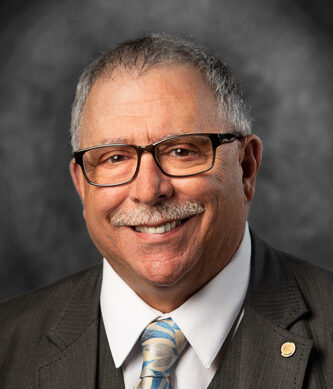
A West Virginia State Senator has introduced a bill that would require public places that have televisions for use by the public to have at least half of those sets activated for closed captioning at all times.
This time, there’s progress on the bill’s advancement.
The legislation was introduced on January 11 in the current 60-day legislative session by Mike Caputo, a Democrat from Marion, W. Va.
Caputo has tried before, on several occasions, he tells RBR+TVBR. But there’s something different this time around, as Senate Bill 251 has just been assigned to a subcommittee to the West Virginia Senate Government Organization Committee.
Could this be a sign the state house will move ahead with a vote on the “Creating Closed Captioning Act”?
It’s a possibility, Caputo says. But even he’s not convinced that will transpire. “Now that it is in a subcommittee, my hope is that they will look at this bill,” Caputo notes. “It’s a good idea. We make accommodations for folks for those with disabilities in buildings, and I think it is an easy fix. A lot of places are already doing, or would probably do it if they thought about it and learned more about it.”
While there is no burden or cost involved, only “showing a little courtesy for the hearing impaired,” Caputo fears SB251′s assignment to a subcommittee with 40 days remaining in the regular legislative session is a mixed blessing. While this is the furthest any bill he’s introduced on captioning has gotten, he admits, “sometimes good bills go to subcommittee to die.”
The “Creating Closed Captioning Act” would have to pass the Senate in time for the House to decide whether or not to put it on the agenda. As such, Caputo is cautiously optimistic something will transpire.
Caputo introduced the legislation after receiving requests and ideas from constituents; he can’t say if there’s a segment of his district that is home to a large segment of deaf or hard-of-hearing West Virginians.
If approved by the West Virginia state house, it would codify into law a new level of captioning needs for both television stations operating in the state, and for vendors that specialize in captioning systems, including ENCO.
According to the National Association of the Deaf, federal law including the Americans with Disabilities Act and the Rehabilitation Act of 1973 presents situations where captioning may be required to provide access to any services that are open to the public. This ranges from concert venues and university lectures to employment, healthcare, and legal services.
And, the NAD says, “Whenever captions are already available (e.g., television) they should be displayed.”
At present, all U.S. broadcasters, cable companies, and satellite television service providers must provide closed captioning for 100% of all new, non-exempt, English language video programming. Closed captioning must also be provided for televised emergency information in some locations.