

For those who have long-followed SiriusXM, the percentage of customers or subscribers who stop using a company’s service or cancel their subscription during a specific time period has proven to be a vital measurement of success. Now, the churn rate has gained a new eye with respect to ensuring subscribers don’t say goodbye, and it is streaming television which is actively looking for ways to keep that rate low.
Hub Entertainment Research has a solution, a newly released report offers. Still, the findings indicate free-to-air TV wins.
For broadcast television, the data found in Hub’s “Decoding the Default” study could prove to be valued counterintelligence as it continues to compete against subscription-based video-on-demand services such as Netflix, Apple+, Amazon Prime Video and the like.
The biggest takeaway: Engagement is key when it comes to keeping the consumer. And, Hub reports, “The clearest signal of that engagement is whether a viewer considers a service their default: the service they turn on first when they want to watch something.”
For many, hitting the Netflix button may be akin to turning the TV on prior to 2010. In 2026, it is more complex than ever to select what to watch. Even finding over-the-air television channels can prove challenging, with “live channels” on most smart TVs an acronym for free ad-supported streaming television (FAST) channels devoid of any local broadcast offerings.
Enter the OTT, which, like SiriusXM, relies on a monthly subscription to keep the lights on, even as advertising is creeping more and more into paid models including Prime Video.
For Hub, “Across paid streaming, free ad-supported services, and live TV, becoming a viewer’s default means more than simply driving usage. Default services are far less likely to be canceled, often remain in households for years, and are the ones consumers are most likely to personalize and make their own.”
By becoming a default choice, the benefit is that it will be the last one to get cut by a consumer. “When viewers are forced to imagine keeping only one service, being someone’s default source is worth two to six times as much loyalty as simply being used,” Hub concludes.
The great news for broadcast TV? “Live linear TV” is the winner when respondents were asked what one programming provider they could keep if that was the lone choice.
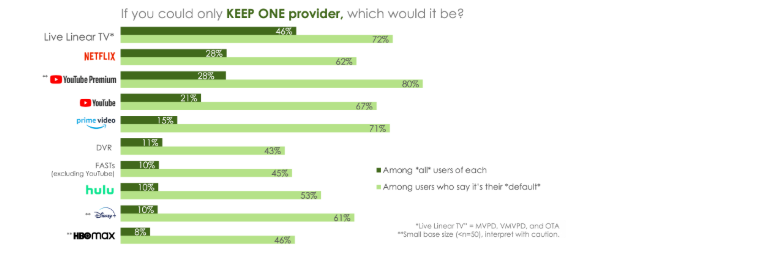
Among all Netflix users, 28% say they’d keep it if they could only keep one service. Among users who call Netflix their default, that jumps to 62%. But, that’s lower than live linear TV (72%) and even Prime Video or YouTube.
Meanwhile, the status of HBOMax in an environment where Warner Bros. Discovery’s nearly complete merger with Paramount has generated numerous stories in recent days shows that the company led by David Ellison has much work to do to gain long-term, loyal users.
“This data illustrates why streaming’s metric of success is shifting from subscriber numbers to engagement,” said Jon Giegengack, a Principal at Hub Entertainment Research and a study author. “It also suggests the benefits that might come from combining Fox and Roku, and partnerships like Peacock and YouTube Premium, or Netflix and TF1 in Europe. These all create combined services that have more than one ‘starting point’ than either platform does by itself. And if you give viewers a compelling reason to start with your service, they will use your service more and stick around longer.”
Hub Entertainment Research’s “Decoding the Default” 2026 study is based on a survey of 1,600 U.S. TV viewers ages 16-74 with broadband access, U.S. census balanced, conducted in August 2026.