

With Core Advertising exceeding the company’s guidance and Political revenue at the high end of its guidance range, Gray Media Executive Chairman and Chief Executive Officer Hilton Howell Jr. expressed satisfaction over the broadcast television station group’s Q1 2026 performance — even as Gray’s now-resolved retransmission consent dispute with Dish impacted the bottom line.
That said, Gray Media is seeing some “softness” in core advertising in Q2 — a matter that Madison and Wall’s Brian Wieser took note of in a fresh investor note.
Nevermind the wider loss Gray Media saw in Q1.
For Howell, a strong mid-term political cycle will likely offset that predicted Q2 core advertising weakness, as new stations — namely the Block Communications Inc. television properties located in Louisville (WAVE-3); Springfield-Decatur, Ill.; and Lima, Ohio, the company officially acquired on Wednesday with the deal’s closing — will bring fresh revenue opportunities.
“As our industry transforms, we continue to find creative ways to drive shareholder value without taking on undue risk,” Howell said in prepared comments ahead of his company’s 11am Eastern earnings call for analysts and investors.
Putting dollars into “innovative sports partnerships” is one way Gray believes it is future-proofing its business, as Howell noted that it is airing 19 Major League Baseball teams across its 16 broadcast sports networks this year. This, he says, is happening as Gray Media continues to focus on the balance sheet, “evaluating accretive M&A opportunities, and attracting the best and brightest talent to Gray.”
Yet, the Q1 results show just how important retransmission consent revenue is for a broadcast TV station owner. Carriage fee dollars declined by 11%, to $339 million, because of that Dish “blackout” and lack of a fresh deal until just days ago. This singlehandedly widened Gray’s net loss attributable to common shareholders widened to $33 million ($0.34 per diluted share), from $22 million ($0.23), as Adjusted EBITDA slipped to $154 million from $160 million. Revenue of $768 million fell short of the consensus estimate based on 5 analysts reporting to Yahoo! Finance by $500,000.
In Q1, core advertising revenue growth of 2% was seen. As Wieser noted in an investor briefing, this compares to 3% growth in Q4 2025 when looking sequentially. He also pointed to Gray’s guidance for flat core advertising growth while looking back to Q1 2022, a similar point in the midterm cycle. Then, core advertising revenue declined by 3.5%, “reinforcing the broader pressure on local TV advertising.”
Looking ahead, Gray expects core advertising revenue to be “down mid-single-digits” in the second quarter of 2026. “That outlook includes a mild tailwind from Gray’s acquisition of TV stations across 10 local markets earlier this month,” Wieser points out, adding, “Overall, Gray’s results fit the broader local broadcast pattern: political spending is becoming a tailwind again, but core advertising remains soft, with digital and acquisition benefits not enough to fully offset pressure in the underlying local TV market.”
With the release of Gray’s Q1 earnings report and Q2 guidance, investors expressed displeasure by selling their shares in NYSE-traded “GTN.” Within 40 minutes of trading on Thursday, shares were off by nearly 12.5%, to $4.85.
GRAY BY THE NUMBERS:
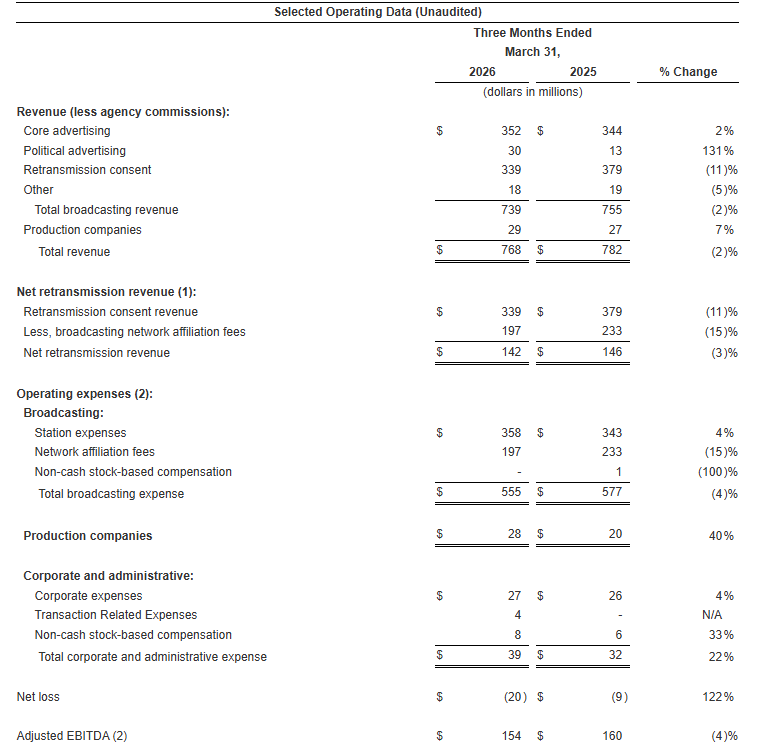
As shown above, retransmission consent revenue declined by 11% — largely tied to the Dish dispute.
In Q2 2026, net retransmission revenue is forecast to come in between $141 million and $143 million.
At the close of Q1, Gray Media’s consolidated total net leverage ratio was 5.94x.
Gray Media’s Board of Directors authorized a quarterly cash dividend of $0.08 per share of its common stock and Class A common stock. The dividend is payable on June 30 to shareholders of record at the close of business on June 15, 2026.