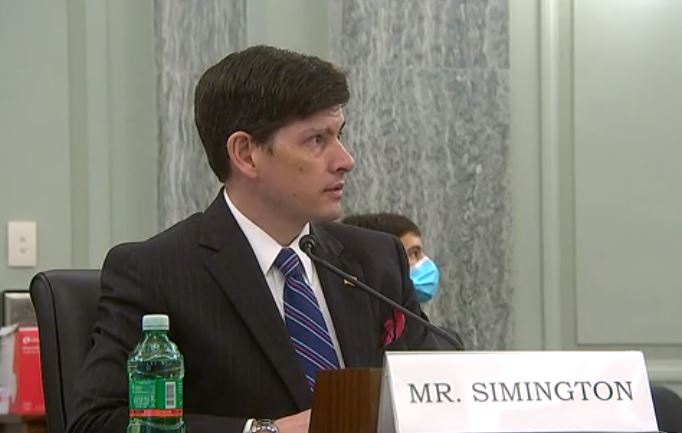
One week ago, the nation’s chief lobbying group representing small, and small market, MVPDs held court with the office of the newest FCC Commissioner.
What did ACA Connects discuss with representatives from Nathan Simington‘s office?
Consolidation in the broadcast television industry and retransmission consent matters.

On January 14, ACA Connects SVP/Government Affairs Ross Lieberman and outside counsel Michael Nilsson met with Simington’s acting Media Legal Advisor, Tyler Bridegan.
Lieberman and Nilsson shared what ACA Connects and its members call ” the tremendous and growing consolidation” in the broadcast industry. This includes both national consolidation (in part because the so-called “UHF discount” to the FCC’s national ownership cap remains on the books) and local consolidation — “in part because of loopholes to the FCC rules limiting local broadcast ownership.”
The result of this consolidation, says ACA Connects: while locally operated association members used to deal with local general managers from local stations, they now deal almost exclusively with corporate representatives.
“This ongoing transformation of the broadcast television industry from something truly
local to something more corporate in nature raises any number of issues for policymakers,” says ACA Connects. “Some of these relate to retransmission consent.”
According to a FCC report, retrans consent fees paid by MVPDs in 2019 rose by 19.2% year-over-year.
That said, broadcast TV station owners have invested heavily in NEXTGEN TV technology, with some companies pouring dollars into local news operations. Bringing ATSC 3.0 signals will also require investment from MVPDs — a big risk, as NEXTGEN TV availability may no longer require many consumers from having to spend upward of $60 each month on cable TV service packages.
Then, there is Locast, the donation-based service that brings local television via the internet.
As such, MVPDs will need to rely further on cable channels, and not broadcast TV — albeit still a primary desire of subscribers — to keep its growth intact in the coming years.
The conversation, however, fueled ACA Connects’ point of view — that retrans consent is harming small MVPDs, and that broadcast TV station owners are the only party to blame.
But, there is one important stat ACA Connects shares that’s worth noting: Small cable operators paid on average $178.13 per subscriber, per year in retransmission consent payments, while large cable operators paid on average $124.67 per subscriber, per year.
With Comcast owning NBCUniversal, it is plausible that it does not pay retrans fees for its O&Os. But, it is unclear over whether this factors into the disparity.
The session also saw Lieberman and Nilsson discuss “a variety of potential steps the
Commission can take to help address concerns about broadcast consolidation and retransmission consent.
“Such solutions could, for example, relate to the national ownership cap, the local
ownership rules, retransmission consent generally, the ‘totality of the circumstances’ test for good faith negotiation, the ATSC 3.0 television format or the proceeding seeking to define the term ‘multichannel video programming distributor,'” Nilsson said.