

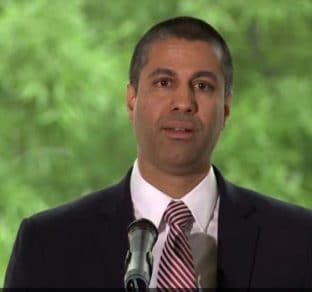
“It’s a simple proposition: the media ownership regulations of 2017 should match the media marketplace of 2017.”
That’s the view held by FCC Chairman Ajit Pai regarding the Commission’s 3-2 vote to do away with its broadcast cross-ownership rules that have prevented a company from owning both a newspaper and a radio or TV property in a market — sans waiver — since 1975.
Several interested parties chimed in with their approval, and dissent.
In his statement on the broadcast ownership rules adopted at today’s Open Meeting, Pai said the Order’s approval does “nothing more” than vindicate the proposition that rules should match the marketplace.
“It’s about time,” Pai said with compassion has he delivered his remarks nearly three hours in to the four-hour November Open Meeting at which the Order was passed.
“Few of the FCC’s rules are staler than our broadcast ownership regulations,” Pai declared. “Notwithstanding the Congressional command that we review and update these rules every four years, they have remained stuck in the past. After too many years of cold shoulders and hot air, this agency finally drags its broadcast ownership rules into the digital age.”
Pai added that the Commission’s decision “is based on the law, the facts in the record, and sound economics. Some say we’ve gone too far. Others say we haven’t gone far enough. I think we’ve gotten it just right.”
Regarding the abolishing of the “eight-voices test” by the FCC, Pai reiterated earlier statements by saying, “We haven’t been able to find any other industry in which the government preemptively decrees that there must be at least eight competitors for a market to be competitive, nor have we found any economic literature justifying this proposition. And, little wonder, for the eight-voices test has as strong a factual basis as does the health myth that you should drink eight glasses of water per day. By ending this entirely arbitrary test, we allow efficient combinations that can help television stations thrive. This is particularly true in small- and mid-sized markets where there may not be sufficient advertising revenue to support eight vibrant competitors.”
One of the first organizations to vocalize their thanks to Pai and the GOP leadership on the FCC was Gordon Smith, the NAB President/CEO.
“These rules are not only irrational in today’s media environment, but they have also weakened the newspaper industry, cost journalism jobs and forced local broadcast stations onto unequal footing with our national pay-TV and radio competitors,” Smith said. “We are grateful the Commission has adopted a common-sense approach to media regulations that will foster innovation, reinvestment in investigative reporting and better service to our tens of millions of listeners and viewers.”
Then came a statement from American Cable Association President/CEO Matthew M. Polka, who blasted the FCC for a vote he says “has set the stage for vast consolidation in local television markets—consolidation that could lead to more blackouts and higher cable bills.”
Polka continued, “When a television station controls one of the ‘Big Four’ networks in a market, it already has small cable operators and their subscribers over a barrel. If it can control two or more such networks, there are few limits to what it can demand, or how much it can punish cable operators who do not cave in to these demands. The FCC knows this because it explicitly found so just three years ago.”
He adds that Congress and the Department of Justice reached the exact same conclusion. Yet today, Polka notes, “the FCC decided it would allow some ‘top-four’ combinations anyway. Under the new rule, stations will still have to show why a particular top-four combination serves the public interest. We think such a showing will be difficult in light of the proven impact on cable subscribers’ pocket books. If the FCC implements its new rule fairly and responsibly, top-four combinations should remain rare – or subject to conditions designed to mitigate these proven harms. We intend to remain vigilant to make sure this happens.”
CLYBURN’S VOCIFEROUS DISSENT
If there was one thing FCC Democratic Commissioner Mignon Clyburn could focus on regarding why she voted no on the Order that does away with 42-year-old rules prohibiting media cross-ownership in the same DMA, it was impossible for her to pinpoint.
Clyburn said there were “glaring problems” with the Order, and that it was “truly hard to decide where to begin.”
Particularly troubling for Clyburn are “loopholes this Commission blesses” by approving the Order — a move that is a “flip-flop from what was decided just one year ago.”
Those were different times, with a confident Democratic majority eyeing the victory of Hillary Clinton in the 2016 Presidential Election.
Now, empowered Republicans are acting on a mantra of modernization. Clyburn isn’t buying it.
“This Order is not about helping small broadcasters or failing newspaper companies,” Clyburn says. “It is about the large getting larger.”
Furthermore, she believes the FCC “abdicated its responsibility to uphold the core values of localism” and looks forward to the day “the court rights this said wrong.”
RBR+TVBR