O’Rielly Speaks, One Day After Inhofe Re-Nom Halt

0

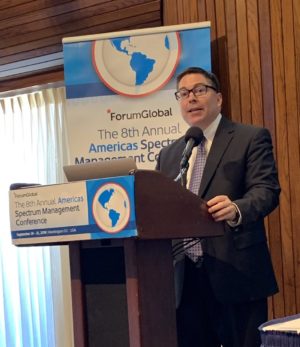
On Wednesday, Republican FCC Commissioner Mike O’Rielly — a fierce champion of increased anti-pirate radio firepower and decreased local ownership restrictions — delivered remarks before The Media Institute.


It’s a Washington, D.C., think tank “working for a strong First Amendment and Sound Communications Policy.”

Yet, what O’Rielly had to say, which was highly relevant to the media industry, may be the secondary story of the week. That’s thanks to a GOP Senator who has placed a hold on O’Rielly’s renomination as a Commissioner by President Trump.


BE SURE TO LIKE RBR.COM ON FACEBOOK! MAKE US YOUR SOCIAL FAVORITE TODAY.



The hold comes courtesy of James Inhofe (R-Okla.). 

What’s the problem? Inhofe wants O’Rielly to publicly state that he will say yes to overturning the FCC’s decision to approve an application from Ligado to facilitate 5G and “Internet of Things” services.

This could be problematic: the Commission on April 19 unanimously adopted an Order and Authorization totaling some 70-odd pages that approved with conditions Ligado’s application to deploy a low-power terrestrial nationwide network in the L-Band.

And, it came with bipartisan support, as noted at the time by FCC Chairman Ajit Pai. 

“The vote at the Commission reflects the broad, bipartisan support that this order has received, from Secretary of State Mike Pompeo and Attorney General William Barr on the one hand to Senator Mark Warner of Virginia and Congresswoman Doris Matsui of California on the other. This vote is another step forward for American leadership in 5G and advanced wireless services.”

However, there was dissent — courtesy of the National Telecommunications and Information Administration. On May 22, the NTIA formally petitioned the FCC to reverse its 5-0 decision.

To be clear, the petition from NTIA was made “on behalf of the executive branch, particularly the Department of Defense and the Department of Transportation.”

At issue with the DoD is its claim that the Commission’s Order and Authorization allows Ligado to use L-band spectrum that is alongside the Global Positioning System. In the department’s view, a terrestrial broadband network in that band of spectrum would create interfere with GPS signals.

In a May 13 letter to the House Armed Services Committee, O’Rielly offered his first hint of how he could react to any sort of political chess game, which Inhofe has executed. He believes the 5-0 vote for Ligado was based on facts and data submitted by federal agencies. Of course, he added, “As with all Commission matters. I remain open to reconsidering the decision if presented with new and convincing evidence and data.”

But, he added, “The Commission’s license modification order extensively addresses the concerns in the record, including those raised by the national security community.”

In the order approving Ligado’s application, the Commission included what it called “stringent conditions” to ensure that incumbents would not experience harmful interference.

For example, the Commission mandated that Ligado provide a significant (23 MHz) guard-band using its own licensed spectrum to separate its terrestrial base station transmissions from neighboring operations in the Radionavigation-Satellite Service allocation.

Moreover, Ligado is required to limit the power levels of its base stations to 9.8 dBW, a reduction of 99.3% from the power levels proposed in Ligado’s 2015 application.

The order also requires Ligado to protect adjacent band incumbents by reporting its base station locations and technical operating parameters to potentially affected government and industry stakeholders prior to commencing operations, continuously monitoring the transmit power of its base station sites, and complying with procedures and actions for responding to credible reports of interference, including rapid shutdown of operations where warranted.

A MELANGE OF MEDIA VIEWS

With the drama surrounding O’Rielly’s future on the Commission as a backdrop, the Republican member of the FCC’s deciding body offered Media Institute Luncheon Series participants wide-ranging comments on the First Amendment, diversity and the media modernization docket, among other topics, via a virtual webinar.

What he did not offer: a response to Inhofe other than noting, “With deep appreciation, my nomination was approved last week by the Senate Commerce Committee. While this is great news, I still have another significant step ahead — consideration by the full Senate — before I can serve a new FCC term.”

But, O’Rielly did make some eye-popping statements with respect to the rapid growth of “over-the-top”, or OTT, platforms.

“If you’re a consumer who likes video content, there’s never been a better time,” he said. “The upheaval of the last several years is redefining what it means to be a media company, and while many are straddling both the legacy and high-tech, unregulated worlds as hybrid operators for the time being, we should expect to see continued restructuring in the near term, and a declining role for the FCC in the long run.”


“While many are straddling both the legacy and high-tech, unregulated worlds as hybrid operators for the time being, we should expect to see continued restructuring in the near term, and a declining role for the FCC in the long run.”


He continued, “In the OTT context, we are getting a rare look into an almost completely unregulated free market, bound only by general consumer protection laws and private negotiations. While I’m not insensitive to the fact that the market will cause short-term pain for some companies and their employees, what we have generally seen so far is that less regulation breeds innovation and expands the overall market for content production and distribution, while increasing access and lowering prices for consumers—a far more beneficial outcome than forcing incumbents to fight for shares of a static pie.”

With that, O’Rielly blasted “certain regulators” for failing to modernize local ownership rules.

“In reviewing mergers, the DOJ has repeatedly and inexplicably failed to properly
identify relevant advertising market participants,” he said. “We have seen the data. There is no question that in DMAs across the country, urban and rural, certain high-tech companies are taking an increasing share of local advertising. Yet, when, God forbid, two television or two radio stations in a market seek to combine, DOJ absolutely refuses to consider the existence of non-broadcast ad sales in its overall analysis.”

That’s not to say there isn’t any good news for legacy media despite these challenges.

“The COVID-19 pandemic has revealed that local journalism is as important as ever, and while the specter of lower ad sales lingers, the strength of local television news has remained steady,” O’Rielly said.

Later in his address, O’Rielly offered additional commentary on the future of broadcast media.

“On the broadcasting front, the entire regulatory model needs to be shredded,” he said. “The level of overregulation is mind boggling.”

Why does the FCC regulate where a broadcast tower is placed so long as it doesn’t cause interference with an adjacent market? Why does the FCC prescribe how a station should maximize OTA listeners or viewers when it is already in the broadcaster’s best interest to do so?

These were the types of questions that perplex O’Rielly, as they point to outdated regulatory policy that needs erasure.

But, he’s a realist. “Until we have the temerity to do the heavy lifting, we’ll have to settle for more moderate reform.”

TO VIEW MIKE O’RIELLY’S SPEECH IN FULL, ON DEMAND, PLEASE CLICK HERE.