


MIAMI BEACH, FLA. — Streaming is actually TV. That’s how younger generations define the digital video distribution and consumption model that is their reality.
This revelation comes from Jill Rosengard Hill, an EVP at Magid. Hill delivered a Keynote address on the second day of the Media Ad Sales Summit, presented by Matrix Solutions, that puts an exclamation point on broadcast TV’s need to get on streamed devices should it wish to retain first-choice relevancy in the years to come.
Magid, known for its custom research, recently conducted an online survey, attracting more than 2,000 respondents, with results weighted on region and ethnicity to provide the most accurate findings.
While the behaviors, trends and opportunities of all video content audiences was taken into account, there’s one key trend that stands out: “Streaming is TV for the younger generation and millennials.”
“Plurals,” the new term coined for the post-millennial generation, are also a force that puts broadcast and cable TV at risk of future audience loss.
With over-the-top TV the focus of a panel discussion moderated by Hill featuring panelists Joel Fineman, Premion’s Director of Publisher Development; Newsy VP/Ad Sales Ken Ripley; and SBTV/Syncbak Head of Product Ron Stitt; Hill took the mic and offered a pre-panel keynote presentation that offers some perhaps alarming statistics for MVPDs — data that could also be of concern to broadcast TV C-Suiters.
Asked of their most common method of watching long-form video content, some 35% of the respondents said it was done via streaming.
This compares to 41% who say they consume content that is “live as it airs on broadcast” television.
Some 13% noted that they engage in time shifting — a statistic that reflects changing ways to consume broadcast TV content.
Then, respondents were asked what platform they most often used to watch “TV.”
For those under the age of 40, streaming was tops.
Yes, live TV is still largely consumed by Boomers and Gen Xers. But, the data show they are also heavy streamers.
That’s not going to slow down. When asked what respondents were doing more of, some 5% said they were engaged in more streaming.
Then, there is the “favorite platform” for watching long-form video content: 37% said they consume programming live as it airs on broadcast, while 37% also note that it is streaming on any device.
That’s on an overall basis. Among younger audiences, streaming wins.
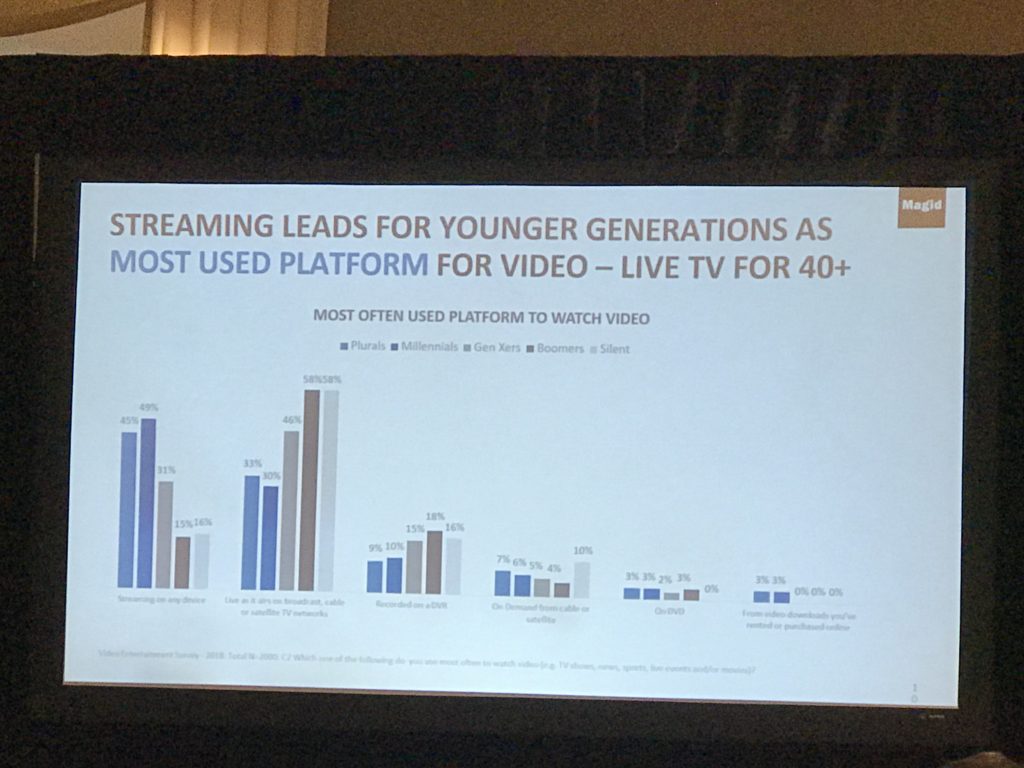
“For those over 40, it is one and the same — streaming is television,” Hill said.
WHO PAYS FOR WHAT
Magid then queried respondents aged 18-64 about their paid SVOD subscriptions.
To little surprise, Netflix wins, followed by Amazon Prime.
Netflix 58%
Amazon Prime 35%
Hulu 24%
HBO Now 12%
YouTube Red 9%
CBS All Access 6%
What about those who aren’t actually paying for SVOD access? Some 30% say they are sharing their password with others, Hill notes.
A LIMIT TO OTT
What’s the ceiling of total SVOD subscriptions Magid respondents are willing to have — and pay for?
Magid’s research puts the magic number at six. That’s significant, as many industry observers have put a maximum of paid OTT services at a lower number.
Of course, price point is a bigger factor, as the respondents’ ceiling on the dollar amount they’re willing to spend per month is just $38 — putting paid OTT access closer to 3, given monthly subscription prices for some of the most dominant streaming platforms.
That said, many questions remain in terms of what will stick, and what will disappear.
“What’s going to happen when Disney and Warner Media come in?” Hill asks. “There are a lot of other services that are direct-to-consumer, that are more niche, that are in the $2 a month to $5 a month subscription. If every cable channel decides to go OTT, there is not much share of wallet left.”
Later, on the panel discussion, the likelihood of an ad-supported Netflix was addressed. Yes, they’re dominant in their space. But, is advertising inevitable? Yes, the panelists believe.
Stitt’s point: “They can’t keep blowing more money to continue to produce programming.”
But Ripley, of Newsy, likens the OTT atmosphere to that seen with Cable TV in 1987. As such, even with an ad-supported Netflix model, NBC and Comcast may be among the big traditional companies behind the curve in offering an OTT solution.
Why do they need to go down that route and succeed? “Marketers don’t have a choice but to invest in the consumer,” Ripley says.
In Fineman’s view, “Netflix will possibly be the one to create a unified identifier to connected TVs.”
Is advertising really an opportunity in the OTT space?
Yes, Magid research finds. While a plurality of respondents (48%) want programming with no interruption from advertisers for an individual fee, some 40% are open to free access with short commercial interruptions. This suggest that spot load continues to be a key concern among consumers, who are now trained to enjoy commercial free, top-quality content thanks to OTT players and first innovated by HBO and Showtime.
AS THE WORLD CHURNS
For radio industry execs that long questioned Sirius or XM’s churn rate, both as a combined company and as competitors years ago, the subject of churn is one that many TV industry C-Suiters may wish to discuss with marketers.
Yes, OTT is huge. It’s growing. But, are fickle consumers making these delivery vehicles difficult for marketers to use?
Magid sees SVOD churn in the 40% range among millennials.
Further, how long one typically intends to have an OTT account is largely determined at the time they subscribe.
“There is very little inertia,” Hill notes. “People are actively turning on and turning off a subscription.”
Baby Boomers are the most determined group of consumers to come in, and promptly leave. Magid research shows this group using OTT platforms for 30 days or less.
Among Boomers, some 32% of respondents intend to cancel their account after watching specific/exclusive video at sign up.
Why? Blame it on what Hill calls “early free access that many content companies used as a way to promote and invite people in, which was working against them as the conversion was set at a very high bar.”
Did these consumers have a bad experience? Did they watch what they needed? If so, “They’re out,” she says.
It’s a difficult strategy, and Hill argues that many new Direct-to-Consumers players don’t know how to play the game.
“Consumers come in and watch this series that [OTT platform operators] have spent millions of dollars to create, they binge-watch, and then they’re out,” Hill says.
With all of the talk about OTT, Hill remarks that some 85% of households still subscribe to cable TV services — and consume linear, ad-supported television.
African-Americans are more likely to be in this group of consumers, possibly as socioeconomic differences between other consumer groups has tempered the level of OTT subscriptions they pay for, on an overall level.
This compares to Caucasian and Hispanic respondents, who overindex on OTT subscriptions.
What should the CMO and brand manager do moving forward as OTT grows, in particular with the key millennial and Gen Z consumer cohorts?
“A bifurcated strategy is needed to maximize younger and older cohorts in the television ecosystem,” Hill concludes, also suggesting that additional strategies are needed to address multicultural audiences.