

In the wake of “a historically strong 2021,” U.S. media owner advertising revenues grew
by 11% to $151 billion in the first half of 2022. That cheery assessment is based on financial reports examined by MAGNA and its EVP of Global Market Intelligence Vincent Létang.
Now, the not so rosy news: The continued economic slowdown and “the lack of major cyclical events” led MAGNA to lower its 2023 growth forecast somewhat significantly.
Those two key factors led MAGNA to put its 2023 growth forecast at 4.8%, downward from 5.8% in its previous report.
While that’s downbeat news for media, in particular Radio, which is eager to fully recover from COVID-19 influenced ad dollar declines starting in Q2 2020, there are welcome signs that some categories will outshine others.
MAGNA expects Entertainment (Movies, Streaming), Travel and Betting to grow advertising spending next year — possibly joined by Automotive as the car market finally stabilizes, MAGNA notes.
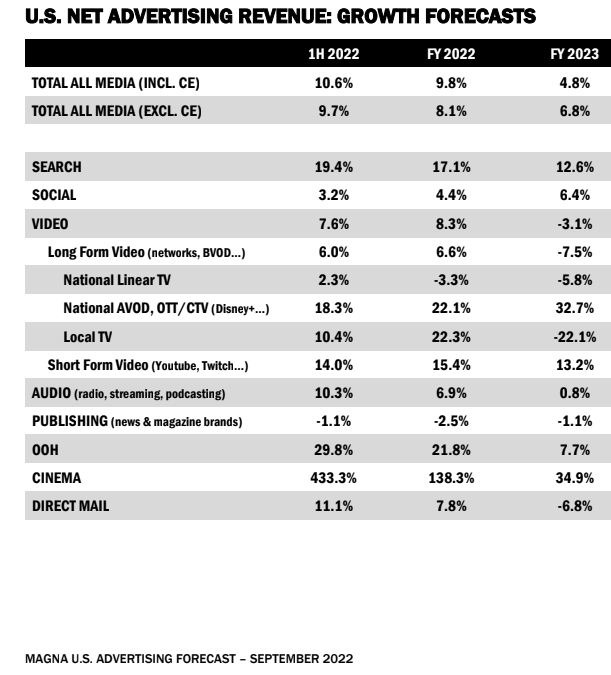
But first, here’s the 2022 trend: Media channel performance varied greatly in the first half with strong revenue growth in out-of-home (+30%) and “robust growth” in keyword formats such as search and retail media) (+19%).
This contrasted against “stagnation in social media,” with 3% growth seen as predicted by some media advertising analysts.
Thankfully, a record-setting year for political ad dollars will make the 2022 totals downright peachy — full-year 2022 media owner revenue will cross the $300 billion market for the first time, reaching $323 billion. “That’s 9.8% above 2021 levels, and 8.1% if we only consider non-cyclical ad spend and exclude political dollars,” MAGNA notes.
That can’t stop the headwinds on the horizon, however.
“Following a strong first half, non-cyclical advertising spending is slowing down as several industries are facing an uncertain economic environment,” Létang says. “There are several growth factors that will help stabilize media owner ad revenues in coming months, however.”
For 2023, Létang expects there to be “multiple organic growth factors, driven by marketing technology innovation.” For example, retail media networks are bringing below-the-line marketing budgets into digital media. Then, there is programmatic spending in digital audio and digital OOH formats, along with the expansion of Advertising-based video on demand and Connected TV advertising with new ad-supported tiers from Disney+ and Netflix.”
LINEAR TV STILL STRUGGLING
When one breaks down the MAGNA data, one thing becomes clear — traditional linear ad sales slowed down in the first half.
National television sales increased 2% to $20 billion, partly thanks to incremental ad sales around the Winter Olympics in Beijing. Local TV sales rose 10% to $9 billion in the first half, thanks to political spending, or +2% on an underlying basis.
For the second half of 2022, local television will attract almost two-thirds of that total, as political ad sales will account for 25% of total local TV ad revenue this year (and more for stations in “battleground” markets).
On a full-year basis for 2022, cross-platform video will grow by 8%. But, linear television will dip by 3%, even as local TV experiences a 22% bump, as will AVOD.
THE AUDIO LOOK
For full-year 2022, cross-platform audio (radio, audio streaming) will increase by 7%, MAGNA says.