


The spread of COVID-19 since late February has created not just a global crisis, but also a “very local crisis.”
That’s the assessment offered by S&P Global Market Intelligence Managing Director of Research Robin Flynn, who served as the moderator and official presenter of the virtual 2020 Kagan Media Summit.
The annual event was originally scheduled for June 18 in New York. Due to the novel coronavirus, the conference evolved to two virtual gatherings, the first of which was held Thursday.
The webinar saw three leading broadcast TV executives share details on the state of their respective businesses in a round-table discussion, following a “state of the industry” review by Flynn.
In her opening remarks, Flynn noted how TV stations “have been right there serving the community” as a lifeline offering local news they can’t readily find through other channels.
At the same time, advertisers have scuttled their planned activity, creating a chasm that’s rather unprecedented: as viewing increased, ad revenue decreased. As such, Kagan is anticipating “a highly unusual drop for a presidential election year.”
Overall, 2020 ad revenue is forecast to finish the year down 10% from 2019, and that’s with an expected $3.1 billion in political ad dollars.
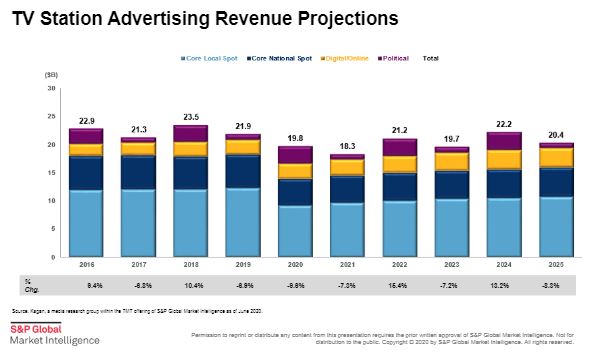
Much of the data is based on the “deep shock” to the industry the COVID-19 pandemic brought to the television business in March and April.
On the whole, broadcast TV in Q2 will see local dollars drop by 30% to 40% from last year. For national, the Q2 year-over-year trend is for a 20% decline.
When will things start to turn around? “The recovery will depend on a multitude of factors,” Flynn says. “Will economies have to be closed down again? And what is going to happen with live sports?”
There’s lots of uncertainty surrounding these questions, and what is happening to some all-important ad categories, including automotive.
As shown in the chart above, another decline is forecast for 2021.
Given all of the uncertainty, a solid recovery may not come until 2022, as some local/national core revenue begins to recover and political ads return to the industry.
THE MULTICHANNEL SUBSCRIBER SLUMP
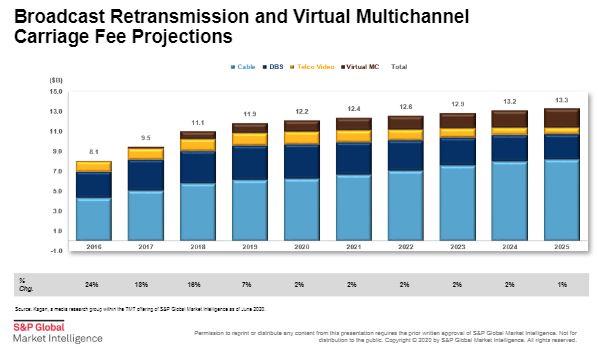
As has been reported by RBR+TVBR, retransmission consent revenue has proven in recent months to be “absolutely critical” to the P&L of broadcast TV companies. This was even more apparent through the height of the COVID-19 pandemic’s lockdown, as Flynn noted it provided “insulation” from the wobbles ad revenue reliance can bring a company.
But, with traditional MVPD subscriptions on the wane, retransmission growth could be slowing.
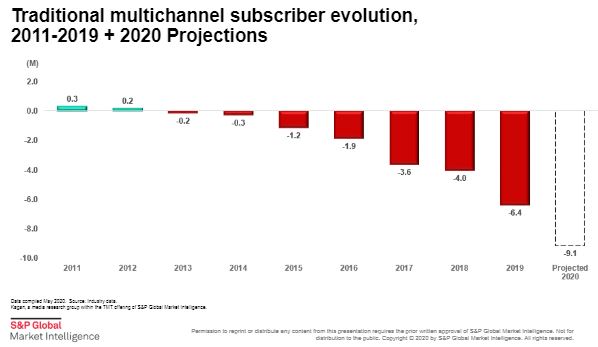
Even with shelter-in-place directives, cable TV service agreements didn’t get a COVID-19 bump. This was reiterated by Flynn. “The [MVPD] industry really didn’t get a break from cord-cutting,” she says. Over-the-top offerings grew.
Still, there is “stability in retrans” as reverse trans are rising substantially.
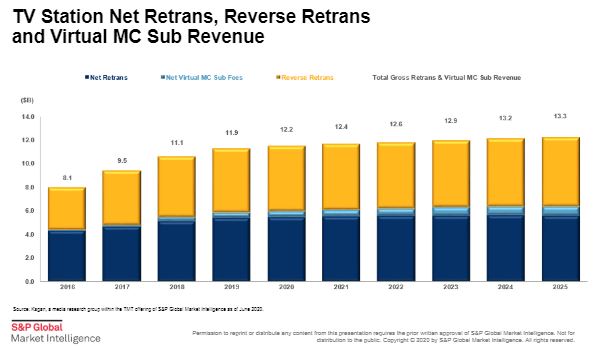
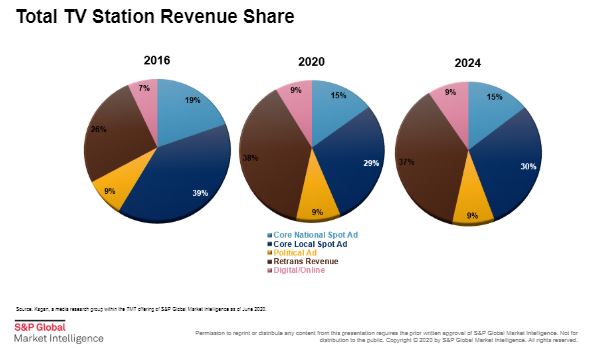
Flynn also noted that core national and local spot revenue, while down, will stabilize.
CLIFF DIVING
In the Q&A session that comprised the second half-hour of the virtual summit’s first of two sessions, with the second scheduled for June 25, Graham Media Group President/CEO Emily Barr was the first of three executives to comment on how the COVID-19 pandemic impacted her station’s business, and what is anticipated in the months ahead.
With stations in Texas, Florida, Michigan and Virginia, Barr said the end of Q1 and Q2 was “no surprise,” given the national emergency tied to the novel coronavirus. “Advertising pretty much fell off a cliff in the latter half of March,” she says. “April was pretty devastating.”
Yet, Graham stepped up by adding newscasts while “first and foremost” ensuring the safety of the news staff.
Barr then echoed what many media executives are reporting: May revenue looks “somewhat better” than April, with June somewhat better than May. “There’s some improvement with respect to the advertising side of the business,” she says.
Similar thoughts were offered by E.W. Scripps Co. President of Local Media Brian Lawlor and Gray Television EVP/Chief Legal & Development Officer Kevin Latek.
Latek noted that at Gray, April revenue tumbled 40% year-over-year. Still, that’s better than some of the reports from radio broadcasting companies, with dips in the 50 percent range.
And, with improvement starting in May and continuing, Latek noted that employee optimism is better than it has been since the start of the pandemic. “We feel we have turned a corner,” Latek says. “We believe the sequential improvements will continue.”
But beyond Q3 … “We have no clue at all,” Latek admits. As such, Gray is not offering any visibility, simply because it’s such an impossibility.
Flynn agrees, noting that in this environment is a challenge one cannot overcome.
THE AUTO TRAIN
While Latek says all advertising categories slumped in Q2, some are coming back more quickly. That includes finance and insurance, home improvement, lawyers, dentists, cosmetic surgery, and a new albeit temporary category — the paid advertising featuring messages of hope and “thank you” notes to front-line workers fighting the coronavirus.
Barr said that Automotive is hampered by its supply train, which seems to be a market-by-market matter.
In Florida markets such as Miami and Tampa, automotive advertising has been substantially higher during local newscasts in the last week.
Where new cars aren’t available, the used car sub-category has proven “very well” in the last month or so at Graham’s stations.
“Over time, Auto will reemerge,” she says. “It just depend on whether or not we hit a second wave of COVID-19 and what that will do with respect to any full or partial shutdowns.”
For Lawlor, inventory challenges, especially in the truck sub-category, are starting to emerge at the automotive dealer associations it works with.
To combat any auto dollar loss, Scripps and Graham can count on election-based revenue. A “very healthy year” will soon unfold for political dollars, and Barr notes Graham’s stations in Michigan and Florida are poised to benefit from not only President Trump and former Vice President Joe Biden but also down-ballot races.
Also notes that he and Emily are expecting a very healthy year on political, and Graham’s Michigan and Florida stations are poised to benefit — in particular from down-ballot races, too.
The second Kagan Media Summit webinar, scheduled for June 25 at 1pm ET, is devoted to “Advertising: Present and Future Trends for Traditional and Digital.”
Kagan Research analyst Seth Shafer will engage in a discussion with S&P Global Ratings Senior Director of Corporate Ratings Naveen Sarma, TVB President/CEO Steve Lanzano, and NBC Spot On SVP Shawn Makhjani.
Flynn says the webinars address topics critical to the future health of the media and broadcast industries.
“While the industry is facing challenges of unprecedented proportions, it is important to me and S&P Global Market Intelligence that we continue to deliver intelligence essential to the media landscape as we go through the COVID-19 crisis together,” she says.