

Gray Television has formally stated its case to the U.S. Supreme Court for looser government regulatory policy when it comes to its desire to own more television stations in markets where it already has a presence.
And, it is doing so with the help of a former Republican FCC Commissioner appointed to the agency by President George W. Bush.
The owner of broadcast TV stations that recently merged with Raycom Media has filed an amicus brief with the nation’s highest court that supports the reversal of a remand order presented to the FCC for its “modernization” efforts that would weaken its now 45-year-old media cross-ownership rules.
Explaining its position, Gray called on Cooley LLP attorneys to prepare and file the brief.
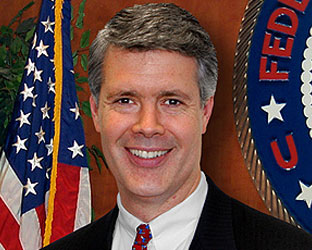
The group of litigators is comprised of David Mills, Elizabeth Prelogar, Barrett Anderson and Robert McDowell.
Of the four, McDowell knows a thing or two about FCC regulatory policy. He was appointed to a seat on the Commission in 2006, and reappointed in June 2009 by President Obama.
Before joining the FCC, McDowell was SVP for the Competitive Telecommunications Association (CompTel), an association representing competitive facilities-based telecommunications service providers and their supplier partners. There, he had responsibilities involving advocacy efforts before Congress, the White House and executive agencies.
While his experience is steeped in telecom, it’s a safe bet he’s in alignment with the light-touch regulatory policy being championed by the Pai Commission — now in its final days, pending the transition of the presidency to Joe Biden.
In a statement issued along with a link to the full amicus brief, Gray asserts, “Over the last 15 years, the FCC has attempted repeatedly to update its regulations in light of today’s competitive media marketplace, as directed to do so by statute. The FCC, however, has been stymied consistently by the U.S. Court of Appeals for the Third Circuit, which effectively has frozen the regulatory landscape as it existed in 1941 when the FCC first adopted a ‘one-to-market’ rule and when the media marketplace was enormously different than it is today.”
Equating the television industry broadcast ownership rules to a pre-World War II America may be surprising to some, but it is a compelling argument from a company thwarted in its efforts to grow in Wyoming because of local ownership caps.
Gray’s 45-page brief argues that the FCC’s rules “should finally be allowed to take effect because the agency issued them in full compliance with its obligations under Section 202(h) of the Telecommunications Act of 1996.”
The TV station owner further contends that the proper interpretation of Section 202(h) is that it requires the FCC to consider—first and foremost—the effects of marketplace “competition” when modernizing its rules. As far as Gray is concerned, “the Third Circuit’s ruling is incorrect because it requires the agency to elevate other policy considerations over the effects of ‘competition.’”
Gray further argues that the Third Circuit’s decision “harms small and mid-sized communities around the nation by depriving them of the benefits of the FCC’s updated
broadcast ownership rules.”
How so? “These communities require substantial investment in order to receive high-quality local news and community programming,” Gray opines through its four attorney representatives. “Gray’s business model and experience in developing and delivering award-winning local news and community programming illustrate firsthand that the FCC’s modernized regulations would facilitate those necessary and important investments.”
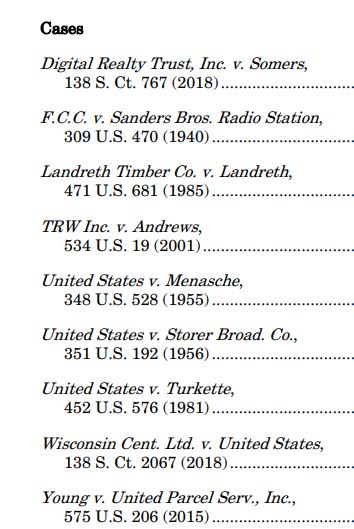
What are the cases that Cooley LLP is using to support Gray’s amicus brief?
They are shown, at left, and number nine in total.
They include FCC v. Sanders Bros. Radio Station, a 1940 case that saw the Court determine, ““[T]he [Communications] Act
[of 1934] recognizes that the field of broadcasting is one of free competition.”
Gray anticipates a ruling by the Supreme Court by June 2021.
FROM THE RBR+TVBR ARCHIVES:

Big Horn Closes On Wyoming TV Deal Following DOJ Gray Slay

ACA Slams Gray For DOJ Blame On Wyoming News Cut

Gray Follows Through With Wyoming TV Donation

Gray’s BIA-boosted Consolidation Argument: News Viewers Win

A Trio Of TV Re-Do Deals In Wyoming
Gray To FCC: Sack Top-Four Restrictions In Small Markets