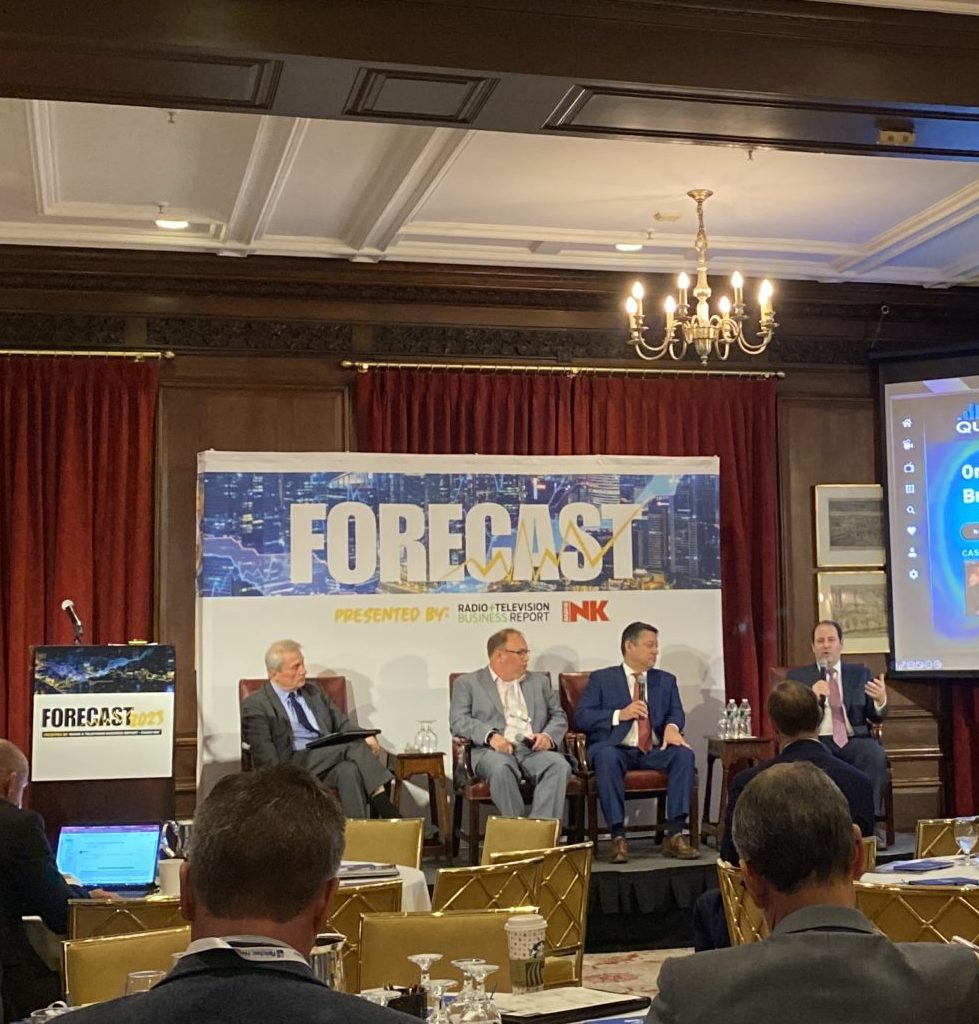
One year ago at Forecast 2022, a discussion was had regarding the fate of Gigi Sohn, the Biden Administration’s nominee to fill the fifth seat at the FCC. At Forecast 2023, held Wednesday in New York, Sohn remained the nominee.
Still a controversial choice, Sohn’s confirmation remains highly unlikely, even as the Senate is headed for a Democratic majority. What’s to come? That’s just one of the Washington, D.C., topics impacting broadcast media in the U.S. discussed at a Forecast 2023 panel moderated by Fletcher Heald & Hildreth Partner Francisco Montero.

Montero began the conversation by noting the “peculiar situation” at the FCC — two Democrats and two Republicans, and a fifth seat that still remains absent. Is Gigi Sohn’s nomination “dead in the water?”, Montero asked.
“Who the heck knows,” replied Robert J. Folliard III, the SVP of Government Relations and Distribution at Gray Television. “Now that we are past the midterms do we see a vote in a lame duck session? Or does the Senate decide that they really need to deal with the debt ceiling so it doesn’t get pushed back to 2023? If the Democrats make it a priority and try to push it through, it could happen.”
Montero wondered if there was any chance Sohn would withdraw as a nominee or if the White House would make a move? Chris Ornelas, the EVP/General Counsel of Beasley Media Group, commented, “Really nothing has changed in terms of who holds the gavels in the Senate and there were still three votes short [on the Democratic side]. Unless these votes flip it will be a high hurdle for her to get confirmed.”
This led NAB Chief Legal Officer and EVP of Legal and Regulatory Affairs Rick Kaplan to note that there are “hurdles that the White House needs to think about.”
With Ornelas putting a stress on “reform,” Folliard noted that two key issues are of interest for broadcast television. One is the “Top Four” rule — something Gray Television is fighting the FCC on in the D.C. Federal Appeals Court — is a big issue. “There needs to be clarity on that ‘Top Four’ rule,” Folliard said. The local ownership cap is also something he believes needs modification of. Ornelas agreed, noting that subcaps and restrictions on the number of stations one can own is important for the radio industry. At the NAB, what Kaplan thought were simple, common sense proposals have been stymied.
Among the other topics of discussion during the session: How to save AM radio.