

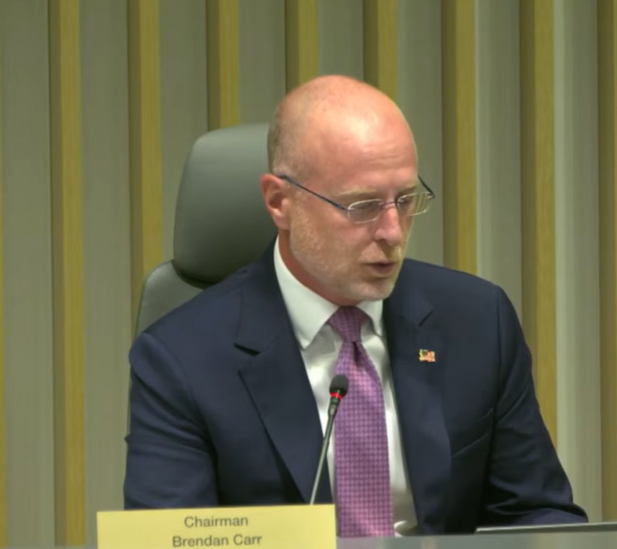
In a lengthy statement that serves to explain the FCC’s 2-1 vote to repeal the 39% national television ownership reach cap codified by Congress in the early 2000s, FCC Chairman Brendan Carr said it is time “to restore balance to the broadcast airwaves” and bring back “a healthy counterbalance to the growing leverage of national programmers.”
Chairman Carr also took great lengths to demonstrate how the FCC has the authority to modify the cap — something he says “is the right policy answer too if you care about the future of trusted, local news.”
Offering his “full support” to the Report & Order adopted at the August Open Meeting but not released via a full Report & Order until October 1, Carr explained that increased scale “will enable broadcasters to attract the capital and advertising revenue needed to sustain and produce trusted and community-focused news and programming.”
And, reiterating earlier comments he’s made, “We should learn from our mistakes with the local newspaper industry, and we should not let the same thing happen to the local broadcast TV industry. Trusted sources of local reporting, broadcast over the public airwaves, are worth protecting and worth fighting for.”
Carr began his statement with a declaration that “localism matters,” sharing that, for decades, the Commission’s media regulations have focused on empowering broadcasters to air programming that responds to the specific needs, interests, and issues of their own communities.
“In my view, it is vital as a country that our future include[s] local reporters working in local newsrooms producing stories that matter to the communities those journalists live in,” Carr continued. “After all, Americans trust their local journalists a whole lot more than the national mass media personalities. The very foundation of our broadcast industry is built on this idea — that local TV stations licensed to local communities air programming responsive to their needs. Congress never envisioned that local broadcast TV stations would become nothing more than undifferentiated passthroughs of national programming produced in Hollywood and New York. But if the FCC does not change course, this could become the reality in many towns and cities and counties.”
Carr’s statement largely goes on to reiterate past commentary about the downward spiral of the daily newspaper business and how the FCC took no action in allowing increased investment in the industry from broadcasters, if they had desired to do so. “When the FCC finally eliminated its outdated restriction on investment in local newspapers, a step it did not take until the first Trump Administration — the damage from agency inaction was all but complete,” Carr said. “A daily local newspaper is hard to come by these days. The industry is largely dominated by a handful of effectively national papers. That is not an outcome consistent with localism. It does not promote a diversity of views. And there is far less competition between papers now, not more. The lesson is clear.”
Thus, Carr concluded, “I don’t want local broadcast TV to go the way of local newspapers. And yet the risk is real. To be sure, big city stations will be fine—the way big city newspapers are fine today. But that will not be the case everywhere.”