HOLLYWOOD — For the last several years, advertisers and marketers seeking to integrate brands into Spanish-language telenovelas airing across Univision Communications‘ two broadcast networks and the Galavisión cable TV channel were limited to what they could accomplish.
Blame Mexican TV giant Televisa for creating what rival Telemundo claimed in many Upfront events was an advantage: It could do product integration and placement across all of its Spanish-language soaps because it produced and controlled the content.
Now, Univision has a solution — thanks to augmented reality.

The first telenovelas to feature digitally inserted visual advertisements are now airing on Univision, thanks to a partnership signed earlier this year between the Miami-based Hispanic media company and Mirriad Advertising.
Mirriad is a video technology company delivering in-video advertising. Its partners include some of the world’s biggest players: In July it inked an agreement with Tencent — the Chinese giant that last week launched an initial public offering to great fanfare.
Mirriad’s first partners in the U.S. are Univision — and, ironically, NBCUniversal. It operates from a New York office, with its global headquarters in London.
What’s fueling Mirriad’s growth on a global level is the growing reality of traditional networks “reducing advertising spend” to compete with digital streaming channels — a.k.a. “over-the-top” entities including Netflix and Amazon Video.
Mirriad’s patented technology involves an in-video ad unit that is naturally embedded into “popular mainstream TV shows and entertainment, while not detracting from the viewing experience.”
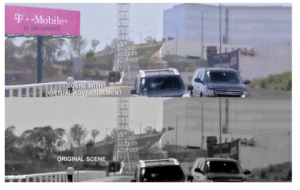
In one scene shared by Mirriad, one telenovela now airs on Univision with a T-Mobile billboard digitally spliced into the original work.
That’s just the beginning. Let’s say a street scene features a Renault with CDMX license plates, making it obvious that the show takes place in Mexico City. Now, Univision can digitially replace the vehicle for one from a U.S. sponsor, with tags reflecting a U.S. state, rather than a Mexican locale.
How does the technology work?
Mirriad’s system is given a completed TV show to analyze. Each scene is reviewed, and judged for unique branding opportunities. Then, Univision will be told that a particular amount of minutes are available in the given episode for product placement.
For Univision, it is a major shift from a long-standing “take it or leave it” pact with its Mexican programming partner, Televisa. This resulted in messaging intended for audiences in Mexico to air in their entirety on Univision; this also extended to script supervision.
Under current leadership, Univision has worked hard to erase these agreements while negotiating with Televisa, a network on a noticeable decline in Mexico against competitor Azteca and, among higher socioeconomic groups, Netflix.
Univision selected Mirriad after seeing its technology in action in Europe and in Latin America, where telenovelas are a popular genre.
For Univision’s sales department, early category interest has come from Hollywood, with feature films have seen billboards in street scenes pop up. Naturally, consumer packaged goods and automotive brands have also proven popular.
While Mirriad’s technology is a boon for Televisa-supplied programming, Univision will also employ it in reality programming found on its UniMás network in 2019.