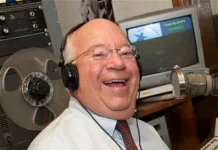
When it comes to radio industry pioneers, Bruce Walton is a name not many people think of. If anything, his name may be better known among fans of the Dallas Cowboys. His brother, Bill Walton, is a professional basketball legend.
Yet, Walton is being remembered in San Diego for establishing one of the first stations to embrace “New Adult Contemporary” programming, later known as Smooth Jazz.
His death comes as a local independent weekly newspaper, citing unnamed sources, reports TEGNA is shopping its KFMB-AM & FM.

After what the San Diego Union-Tribune called “years of failing health,” Bruce Walton passed away Oct. 18 at the age of 68.
As a National Football League player, he appeared as a Cowboys team member in Super Bowl X. His pro career followed a stellar collegiate performance as a defensive tackle for UCLA, where he declined an offer from basketball coach John Wooden to join his squad.
Bruce Walton’s NFL career would come to an end following the 1975 season, when a knee injury prevented him from continuing. He found his way into radio sales, and by 1982 was VP/GM of KIFM-FM 98.1 in San Diego, licensed to West Coast Media.
At this time, Walton was fighting the FCC over something that threatened KIFM’s license — violations dating to his time at UCLA. In the early 1970s, a lack of non-entertainment programming — meaning no public affairs or news programs were heard — put the former KDIG-FM’s license renewal on ice, as a 1972 FCC ruling allowed the financially scrapped station to cutback such programming to 1.1% of its airtime until its next license renewal filing. However, in 1974 a FCC Administrative Law Judge declared KIFM had fallen short of its promise, and gave the licensee a one-year renewal. The FCC overruled, and took away the license altogether. West Coast Media continued to fight. In December 1982, the U.S. Court of Appeals upheld the FCC’s denial.
A distress sale of KIFM to a minority buyer was then put into play. The FCC wouldn’t let that happen, however, and a 4-1 ruling made in June 1984 blocked such a move. This put West Coast in a position where it could only be an interim operator, until a sale was consummated. In an interview with Radio & Records, Walton estimated the value of the station to be between $6 million and $7 million, and predicted a stampede of applicants.
Meanwhile, KIFM was getting noticed around the nation for transitioning its programming from “the mellow sound” and a Rock AC presentation popular in the late 1970s and early 1980s to something new and different, and jazz influenced.
In Spring 1982, Walton put “Lites Out San Diego” on KIFM, to much success. Interestingly, a 1986 profile in R&R compared KIFM to WQXI-FM (94Q) in Atlanta — a station that would eventually become a sibling to KIFM. Both stations aired the precursor to Smooth Jazz after dark, and with a surge in product KIFM in September 1987 embraced the format 24/7 — even after then-PD Bob O’Connor told R&R that such music outside of nights and weekends wouldn’t be successful.
He was proved wrong, as KIFM — now under control of American Finest City Broadcasting — expanded the programming it had been overseeing since July 1, 1986.
What happened to Walton? A year earlier, in mid-1985, he segued to management, programming and sales partner Unidyne Broadcasting. This put Walton in charge of all sales for not only KIFM, but also Tijuana-based XHITZ-FM, today known as “Z90.”
After a decade of success, and a loss of license well in KIFM’s past, the coming Telecommunications Act of 1996 created an opportunity for Walton and his investors to cash out. In late January 1996, KIFM — now under Walton’s control through licensee KIFM Broadcasting L.P. — was sold to Jefferson-Pilot Communications for $28.75 million.
Peter Handy of Star Media Group served as the broker of record.
While KIFM eventually came under the control of Clarke Brown‘s group, it didn’t come without a new FCC fight. A request to block the sale of the station was made by three co-owners who had partnered with Walton: Josie Calderon, Elida Chavez, and Marta Concha. The limited partners claimed they had a a contractual right under their partnership agreement to approve the sale of the station and did not give their consent to KIFM’s sale.
The FCC said the matter was not up to the agency but up to the Superior Court
of California for San Diego County. The court ruled in favor of Walton and Jefferson-Pilot.
Today, KIFM is Entercom-owned Classic Hits KXSN-FM “Sunny 98.1,” modeled after WOCL-FM in Orlando. The Smooth Jazz programming formally concluded on August 19, 2013, some two years after making format tweaks prompted by the format’s decline.

For Walton, he’d long moved on to commercial real estate, serving as VP of Development for Terramar Retail Center in San Diego. In 2008, he became VP/Government Affairs for the organization behind the Rock n’ Roll Marathon.
Walton’s health began to decline in 2017, culminating in his placement into a medically induced coma.
He rallied, but relied on a walker while coping with extreme hearing loss until falling ill once again.
FAREWELL TO FORMER MIDWEST PAIR?
In February 2018, RBR+TVBR reported that there were no immediate moves at KFMB-AM 760 and KFMB-FM 100.7 in San Diego, following their acquisition by TEGNA as part of a bigger deal — the purchase of CBS affiliate KFMB-8 — from Midwest Television.
Among RBR+TVBR’s observations at the time: Mark Larson was still on the AM; Thin Lizzy and Fleetwood Mac were on following “The DSC” on the FM, courtesy of veteran market talent Robin Roth; Carlo Cecchetto and Barbara-Lee Edwards were still set to anchor the afternoon and nighttime newscasts on the TV station.
After 18 months, it now seems TEGNA is not committing to radio station ownership in San Diego. According to the San Diego Reader, TEGNA “is in the process of spinning off” KFMB-AM & FM. It added that local radio staff learned of the plan last week.
While he declined to comment to the free weekly on the report, KFMB GM Alberto Mier y Teran told the publication in May 2019, “On weekends there is no one in the building to do local radio on KFMB-AM.”
The Reader then went on to note Larson’s tepid ratings among Adults 25-54.
What it didn’t note is that “The DSC” as KFMB-FM listeners knew it is no more: Shelly Dunn retired in August 2018, while Dave Rickards and “Chainsaw” continue at the station where they first formed “The DSC” — iHeartMedia-owned Classic Rocker KGB-FM 101.5.
The loss of the popular morning show placed former 91X veteran Chris Cantore in morning drive another former 91Xer — Robin Roth — is in middays.
Both could be seeking new radio homes soon. According to the Reader, investors were told to submit their offers to TEGNA, “which would announce a new owner by November 15.”
Further, there were no bidding minimums. The Reader quoted insiders as saying the value of the stations is in the range of $8 million-$10 million — a far cry from the payday Walton saw for the sale of KIFM more than 20 years ago.
While iHeart was mentioned as a potential buyer of the stations, it would need to divest one AM and another FM for such a transaction to transpire. This could see KLSD-AM 1360 “upgrade” to KFMB-AM’s superior Class B facility in Santee, Calif.
At the same time, Class B KSSX-FM 95.7 could be traded for the better KFMB-FM. While both are Class B stations, KSSX has first-adjacency concerns with Meruelo Media-owned KLOS-FM 95.5 in Los Angeles in many parts of San Diego County.
A potential buyer for KSSX is Educational Media Foundation, as this would give its Worship Music-format Air1 much-improved coverage of an important market for Christian Contemporary Music. EMF already has a presence in the market via KLOVE affiliate KLVJ-FM 102.1, the former KPRI. EMF acquired KLVJ in September 2015.