Well, that didn’t take long. Just 18 days after the Supreme Court’s 6-3 decision to end the “Chevron deference,” the National Association of Broadcasters has filed an initial brief in its challenge to the Federal Communications Commission‘s local radio and television ownership restrictions.
And, it is joining privately owned radio broadcasting companies and a broadcast TV affiliates association in drafting an 80+-page consolidated petition released Tuesday afternoon by the NAB.

The timing of the initial brief comes following the June 28 decision in Loper Bright Enterprises et. al. v. Raimondo to end 40 years of yielding to federal agency experts to resolve matters of ambiguity as they pertain to regulatory policy challenges in the courts. This gives more firepower to the judicial branch of the federal government, and with the ruling many D.C. insiders believed it would result in a flurry of challenges.
Enter the NAB, which has consolidated petitions with Zimmer Radio of Mid-Missouri Inc., and the ABC Television Affiliates Association through their representative counsel. Also involved are Beasley Media Group, Nexstar Media Group and Tri-State Communications Inc.
Barbara Smith of BCLP LLP is representing Zimmer Radio, while four Gibson Dunn & Crutcher attorneys are working along with the NAB legal team led by Rick Kaplan and Jerianne Timmerman.
Ashley Johnson of Gibson Dunn & Crutcher is representing Nexstar, the nation’s No. 1 owner of broadcast TV stations; Nexstar in late February sued the Commission for tightening its local broadcast TV ownership rules in its severely delayed 2018 Quadrennial Order.
Paul Hastings LLP attorneys are working on behalf of Nexstar and Tri-State.
In the full petition, which can be downloaded in PDF form by clicking here, the groups challenge the Commission’s broadcast ownership restrictions, including its decision “to increase the regulatory burden on [the] industry in what Congress intended to be a deregulatory exercise: the Commission’s periodic review of its broadcast ownership rules.”
That would be the quadrennial review of its rules required with the signing into law by President Clinton of the Telecommunications Act of 1996, which opened the floodgates for radio industry consolidation. While some argue that some companies got too big, the contrarian view is that, in some smaller markets, one company should be free to own all of the radio stations, as they do not compete against other radio stations for advertising dollars but against unregulated digital media.
Then, there are the local TV rules, which could see a thaw in the near future. In a move that turned heads in legal circles, the FCC’s Media Bureau, headed by Holly Saurer, in June gave its approval to a swap of stations between Brian and Patricia Lane’s Marquee Broadcasting and Gray Television. This saw Saurer grant a waiver to the Commission’s “Top Four” rule — something at the crux of Nexstar’s legal challenge against the Commission.
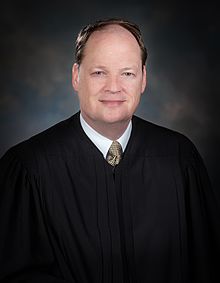
Fast-forward to today, and a case that was filed not in the District of Columbia but in the U.S. Court of Appeals for the Eighth Circuit, in St. Louis. That venue, led by Chief Judge Steven Colloton (pictured, top left) was selected because of Zimmer’s presence in the state of Missouri. And, it has historically been overwhelmingly composed of conservative judges, giving the case more firepower than perhaps in a more liberal-leaning court.
In the case summary, in which a request for oral argument is made by the petitioners including the NAB, Nexstar, Zimmer, Beasley and Tri-State, the argument is made that the Commission’s Local Television and Radio Rules “retain and even tighten decades-old restrictions on which—and how many—television and radio stations broadcasters may own in a particular geographic market.”
The rules, they argue, “are premised on the notion that broadcasters could exert disproportionate influence by shaping news and entertainment options. But that idea is a relic from a bygone era—before the emergence of the Internet, smart phones, social media, and streaming. In reality, broadcasters today struggle to keep pace with rapidly proliferating audio and video platforms that are steadily taking audience share and advertising dollars. Instead of making it harder for broadcasters to compete, the Commission should have modernized its outdated rules because they are no longer justified.”