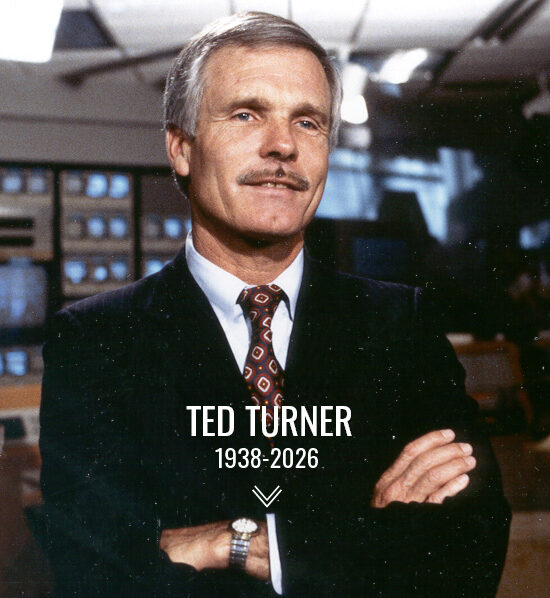
From his ownership of Major League Baseball’s Atlanta Braves to taking WTBS-17 and making it a nationally distributed cable TV superstation, creating Cable News Network against a legion of detractors who dismissed the idea, and later developing Turner Broadcasting — today within the Warner Bros. Discovery family — Ted Turner was audacious, leaving an imprint across multiple decades.
In recent years, health challenges literally crippled him. Now, Turner Enterprises has confirmed his passing at the age of 87 after a long battle with Lewy Body Dementia.
FROM BILLBOARDS TO BROADCASTING
A native of Cincinnati, Turner would graduate from Brown University in Providence, R.I., and take a job at his father’s outdoor advertising company. The younger Turner would become President following the death of his dad.
As the head of Turner Advertising Company, Ted Turner saw broadcast media as a promising expansion area. He purchased five radio stations in the Southeast, but sold them in order to gain the funds necessary to acquire what was first known as WTCG-17 in Atlanta.
That station would become WTBS, the forerunner of today’s TBS MVPD-distributed channel. As a “Superstation,” WTBS was known for syndicated fare and as the home of the Braves. That’s because Turner purchased the MLB team for $12 million at the start of 1976, a move that kept the team in Atlanta. For many seasons until the early 1990s, the Braves were the butt of jokes, with little aside from Dale Murphy in the way of star power. Yet, the Braves’ national audience would only grow thanks to WTBS. Clever marketing was also used — something Turner developed a knack for.
With the Braves now his, the 1976 Atlanta Braves took the field with pitcher Andy Messersmith wearing No. 17. Across May and June of that year, he wore a uniform that instead of bearing his surname, bore the word “Channel.” It was free publicity for WTBS’ dial position, while it lasted.
That bravado led Turner at the dawn of cable television’s expansion to create Cable News Network. It was the world’s first 24/7 live television news operation, taking a cue from local all-News stations owned by Westinghouse and CBS on the radio side of the business. With its June 1, 1980 debut, some thought Turner made an error, and was at the helm of a money-draining operation. Not so. By 1982, the forerunner for CNN Headline News was born. In 1985, CNN International came to light.
In 1996, with Turner Network Television (TNT), Turner Classic Movies (TCM) and the Cartoon Network now in the cable TV channel mix, Turner sold his media assets to Time Warner for $7.5 billion. He would take the role of Vice Chairman, keeping leadership of the networks. Then came Time Warner’s 2000 merger with AOL, the former America Online, on the even of the “dot-bomb” troubles. Three years later, Turner resigned from his role; his finances were challenged. By 2001, a decade of marriage to actress and activist Jane Fonda had ended, too.
“I lost Jane. I lost my job here. I lost my fortune, most of it. Got a billion or two left. You can get by on that if you economize,” he told CNN’s Piers Morgan in May 2012.
Turner was married three times. His first marriage to Judy Nye produced two children: Laura Lee (“Laura”) and Robert Edward, IV (“Teddy”). Turner later married Janie Smith, with whom he had three children: Rhett Lee (“Rhett”), Reed Beauregard (“Beau”), and Sara Jean (“Jennie”). Despite their divorce, Turner and Fonda remained close friends.
In addition to his media industry achievements, Turner also secured a place in sailing history in 1977, as he led the Courageous crew to America’s Cup victory. In 1990, he established the Turner Foundation, focused on safeguarding habitats, bettering communities, sustainable living, and environmental protection.
In 1997, Turner made history by pledging $1 billion to the United Nations. The following year, he founded the United Nations Foundation, which operates offices in both New York and D.C. and focuses its efforts on issues such as women and children, disease, and energy and climate. In 2001, Turner co-founded with Senator Sam Nunn, the Nuclear Threat Initiative, whose core objective is to eliminate nuclear, biological, radiological, chemical and cyber weapons, which Turner believed to be society’s most pressing issue.
Up until his passing, Turner served as co-chairman of Turner Enterprises, Inc., (TEI) with offices in Atlanta and Bozeman, MT, which managed his business interests, investments, and landholdings, including his 45,000 bison herd. A longtime proponent of clean energy sources, Turner created a renewable energy division within TEI – Turner Renewable Energy – which has collaborated with companies on large-scale solar projects.
Then, there is Ted’s Montana Grill, which he co-founded in 2002 with restaurateur and Longhorn Steakhouse founder George McKerrow. The fine dining establishment features the largest bison menu in the world, operates dozens of locations across several states, and implements numerous, environmentally conscious practices within its restaurants.
In respect to the legacy, he wished to leave, it was a simple, yet lofty one: “to make our world a better, safer place than it was when I got here.”
The family has planned a private service. A public memorial will be held at a later date.
At the time of his death, Ted Turner was also one of the largest private landowners in the United States with more than two million acres.