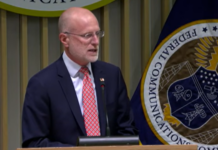
To help meet the increasing demand for Wi-Fi and other unlicensed services, the FCC at its November Open Meeting on Wednesday adopted new rules that “modernizes” the 5.9 GHz band.
As the Commission sees it, the new regulations will lead to better automotive security, while bringing better wireless internet services to Americans.
Specifically, the Commissioners approved a First Report and Order, Further Notice of Proposed Rulemaking, and Order of Proposed Modification that adopts rules to repurpose 45 megahertz of spectrum in the 5.850-5.895 GHz band for unlicensed operations, retain 30 megahertz of spectrum in the 5.895-5.925 GHz band for the Intelligent Transportation Systems (ITS) service, and require the transition of the ITS radio service standard from Dedicated Short-Range Communications technology to Cellular Vehicle-to-Everything technology.
As of today, Wi-Fi carries more than half of the internet’s traffic. Across the COVID-19 pandemic Wi-Fi connectivity has grown in importance, as Americans use it for connecting to videoconferencing, telehealth, and other critical applications and services. Offloading mobile data traffic to Wi-Fi has also helped keep America’s cellular networks from being overwhelmed and will continue to do so in the future. By one estimate, the economic value created by Wi-Fi in the United States is projected to double by 2023—reaching nearly $1 trillion.
The FCC’s new rules making 45 megahertz of the 5.9 GHz band available for unlicensed use is of keen interest to many in the broadcasting industry. Why? The FCC explained that this spectrum’s impact will be further amplified by the fact that it is adjacent to an existing Wi-Fi band which, when combined with the 45 megahertz made available today, will support cutting-edge broadband applications. These high-throughput channels—up to 160 megahertz wide—will enable gigabit Wi-Fi connectivity for schools, hospitals, small businesses, and other consumers.
The Report and Order adopts technical rules to enable full-power indoor unlicensed operations in the lower 45 megahertz portion of the band immediately, as well as opportunities for outdoor unlicensed use on a coordinated basis under certain circumstances. Under the new rules, ITS services will be required to vacate the lower 45 megahertz of the band within one year.
The new rules also will improve automotive safety by reserving the upper 30 megahertz of the band for Intelligent Transportation System (ITS) services and designating C-V2X as the technology standard for safety-related transportation and vehicular communications. C-V2X uses cellular protocols to provide direct communications between vehicles and obstacles like other vehicles, cyclists, pedestrians, and road workers, and to receive safety information from roadside transmitters. C-V2X has gained momentum both domestically and internationally. While the Commission designated Dedicated Short-Range Communications (DSRC) services as the technology standard for ITS services over twenty years ago, DSRC has not been meaningfully deployed, and this critical mid-band spectrum has largely been unused for decades.
“Today’s action therefore begins the transition away from DSRC services—which are incompatible with C-V2X—to hasten the actual deployment of ITS services that will improve automotive safety,” the FCC notes.
In addition to the new rules, the Commission adopted a Further Notice of Proposed Rulemaking which proposes technical rules for outdoor unlicensed operations across the United States (except for limited number of areas) in the lower part of the band once ITS operations have vacated that spectrum. The Further Notice seeks comment on how to transition ITS operations in the band to C-V2X-based technology, including the appropriate implementation timeline and technical and operational parameters for C-V2X service. The Further Notice also seeks comment on whether the Commission should allocate additional spectrum for ITS applications in the future.
Finally, the Commission also adopted an Order of Proposed Modification which proposes to modify all 5.9 GHz band ITS licenses in accordance with the Nov. 18 changes.