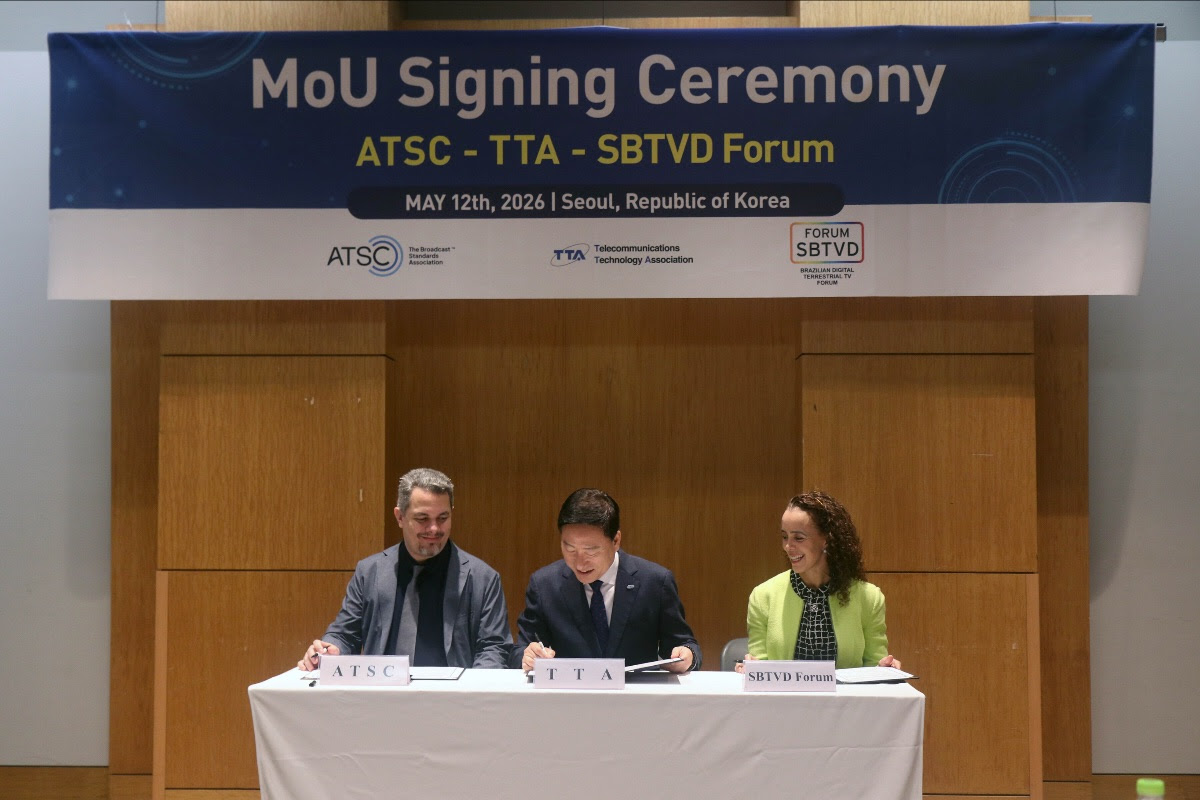
WASHINGTON, D.C. — A trio of key standards development organizations have signed a Memorandum of Understanding that establishes a formal framework for cooperation on the development, harmonization, and worldwide promotion of next-generation terrestrial broadcasting standards.
The agreement between ATSC, the domestic broadcast standards association; Sistema Brasileiro de TV Digital Terrestre (SBTVD) Forum, responsible for Brazil’s digital terrestrial television system standards; and Korea’s Telecommunications Technology Association reflects what the ATSC calls a shared commitment to strengthening global interoperability for advanced broadcasting services and to accelerating international collaboration around the evolution of ATSC 3.0 and related technologies.
The collaboration was made official last week with a signing ceremony in Seoul.
Under the MOU, the three organizations will collaborate on the development of broadcasting standards and recommended practices, support testing and certification activities, exchange technical and strategic information, and coordinate joint industry engagement efforts across key global markets. The partnership is particularly significant, ATSC notes, as broadcasters worldwide continue transitioning toward IP-based, software-defined, and integrated broadcast-broadband delivery systems enabled by ATSC 3.0 and related next-generation standards.
All three standards organizations agreed to hold regular coordination meetings aligned with major international broadcast industry events, including NAB Show in Las Vegas, KOBA Show in Seoul, and SET Expo in Sao Paulo.
“This agreement represents an important milestone for the global broadcasting industry,” said ATSC President Madeleine Noland. “By aligning efforts across North America, South America, and Asia, we are creating a stronger foundation for interoperable next-generation broadcasting technologies that will benefit broadcasters, manufacturers, developers, and viewers worldwide.”
The MOU establishes several key areas of cooperation, including:
-
Collaboration on next-generation broadcasting standards and recommended practices
-
Promotion of worldwide interoperability for terrestrial broadcasting services and products
-
Coordination on testing and certification of broadcasting equipment and services
-
Support for cross-referencing and harmonization of technical standards
-
Exchange of technical and strategic information between organizations
-
Joint communication initiatives, including sharing press releases and member newsletters
-
Appointment of liaison officers to coordinate collaborative activities
-
Consideration of expanding participation to additional standards development organizations adopting ATSC 3.0 or related technologies.