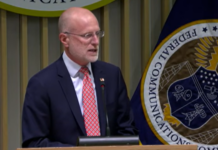
It was hardly unexpected. The Ranking Member of the Senate Committee on Commerce, Science & Transportation, in her opening comments, lashed out at FCC Chairman Brendan Carr for engaging in what Democrats have labeled politically motivated and Freedom of Speech-limiting efforts by the Commission.
Maria Cantwell, the Senate Democrat from Washington, also took aim directly at Carr.

The words came at the start of the committee’s first oversight hearing since 2020, and following cordial words from Senate Commerce Committee Chairman Ted Cruz (R-Texas) of Carr and his leadership under the second Trump Administration.
Consideration by some groups that spectrum should be taken away from broadcast television stations “because maybe they’re not getting as much use and maybe we should have less competition” was singled out by Cantwell in her opening prepared statement.
She then veered toward the specter of artificial intelligence and its increased use across broadcast media, both in the back-office, in the studio and in some cases on camera. “It’s clear to me that [at] the FCC, we need to everything to protect consumers, including protecting them from the harms of AI,” Cantwell said.
There was also a jab at Carr’s decision to acquiesce to Daniel Suhr and the Center for American Rights by reinstating a trio of “media distortion” claims that had been dismissed under delegated authority by acting bureau chiefs in the waning days of the Rosenworcel Commission. And, Cantwell addressed Carr’s comments on a podcast triggering the September Jimmy Kimmel Live! uproar spurred by the ABC late-night host’s false commentary regarding the alleged assassin of conservative political activist Charlie Kirk.
With costs of media services to consumers also a priority issue to Cantwell, she meshed that FCC regulatory watchdog desire with commentary that offered a warning to Carr regarding the expected loosening of media ownership limits, stating that too much consolidation would limit competition in radio and TV. “Local news and independent voices matter, and consolidation undermines that independence and drives up costs,” Cantwell said. “People across the political spectrum agree — there’s too much control in a few hands. Chris Ruddy, CEO of Newsmax, has spoken about how corporate consolidation threats local news. Chairman Carr, what are we doing to make sure that you are going to continue to protect local media ownership and grow this opportunity?”
Cantwell concluded that “we do not want to see content that is produced nationally for local broadcast.” Yet, that is exactly what is driving companies such as Sinclair Inc. and The E.W. Scripps Co., with many local newscasts fed by coverage produced in Washington, D.C., or a central studio and newsroom. For Cantwell, however, a “station undermined” by not being able to report on a local weather emergency is an existential threat of increased consolidation.
PROTECTING LOCAL BROADCASTERS AND JOURNALISTS
“The FCC’s independence is central to projecting free and diverse press, to strengthen our national security, and bringing down the cost of telecommunications in media services,” Cantwell said as she continued her prepared remarks. “However, what we’ve seen this year and costs that Americans are facing … prices are rising. The question is, ‘What is the Chairman of the FCC and the FCC doing to bring down costs to consumers?'” she asked.
Cantwell continued by saying “the American people deserve an FCC that protects them from hidden fees and promotes affordability.” The FCC, however, in her mind “is doing just the opposite in allowing consolidations that reduce competition and can help drive up costs.”
With costs for streaming and cable on the rise, along with wireless services, Cantwell asked what the FCC is doing to help drive down those costs. She pointed to bipartisan legislation passed by Congress to make that happen, providing billing transparency. But, Cantwell asserted, “Chairman Carr has proposed to punch holes in those rules.” To implement that, he — not the Commission as a whole — “is making it easier for big corporations to tack on hidden fees” to internet bills … Instead, I see an FCC that is not focused enough on affordability.”