

How robust was the broadcast deal market in the first quarter of 2022? Volker Moerbitz of S&P Global Market Intelligence’s Kagan media research unit crunched the numbers.
The first three months of the year experienced the highest quarterly deal volume since the third quarter of 2019.
Kagan puts the total deal value for Q1 ’22 at $11.05 billion.
How significant is that? “In the last 40 years, quarterly volumes exceeded $10 billion only eight times,” Moerbitz finds. “Most of these mega-volumes were due to one large consolidation deal or privatization deal, and first quarter 2022 was no exception.”
Fueling the deals in the first quarter of 2022 — The Standard General/Apollo Global Management joint privatization bid for TEGNA, presently under regulatory review.
The $24-per-share deal was announced on February 22, and if the FCC says yes it would take TEGNA, the third-largest TV station owner by revenue, off the stock market.
Just how big, dollar-wise, is the deal crafted by longtime dissident shareholder Soo Kim?
“We estimate the value of TEGNA’s 64 full power and three low-power TV stations at approximately $8.71 billion, making it the second-largest transaction in broadcast deal history,” Moerbitz says.
In fact, the TEGNA proposal is topped only by the 1999 Viacom/CBS merger. “We estimated the value of the TV stations at $8.75 billion,” Moerbitz says of that 23-year old transaction.
Spin-off deals tied to the TEGNA privatization effort also added to the dollar total for Q1 2022, with $1.3 billion assigned to Cox Media Group’s assumption of TEGNA stations in Dallas, Houston and Austin.
Additionally, some $11.5 million was assigned to properties TEGNA has in Columbus, Ohio.
Meanwhile, Cox will acquire a group of four stations currently owned by Standard General affiliate Community News Media LLC, and an unspecified Standard General affiliate will acquire Cox’s FOX outlet WFXT in Boston. These two transactions will need to close before the TEGNA acquisition.
Near the end of the quarter, on March 30, Cox Media Group announced another large transaction — one that raised eyebrows. It was the sale of 13 full-power stations in 11 markets to Imagicomm Communications LLC, parent company of the cable TV-distributed INSP network. The value of this deal comes in at $488 million.
According to Moerbitz, the top five transactions for the quarter totaled $10.93 billion and accounted for 99% of the quarterly deal volume.
The other 126 transactions still add up to a respectable $115.9 million, he notes.
The other transactions include the sale of Curtis Squire subsidiary Red River Broadcast Co.’s last remaining stations to Forum Communications for $24 million. The two main TV stations involved are the FOX affiliates in the markets of Fargo, N.D., and Duluth-Superior, Minn.-Wis. The stations come with three full-power and seven low-power translators.
RADIO’S Q1 DEAL PORTRAIT
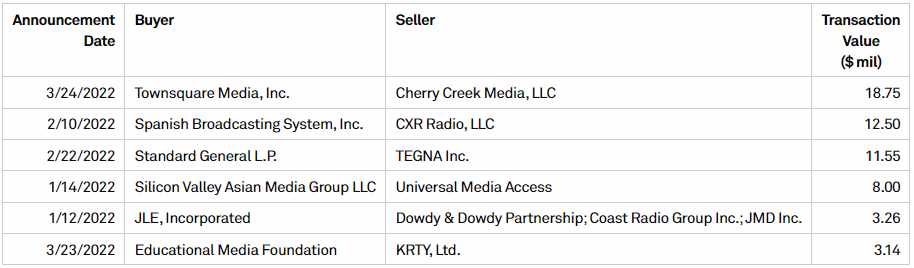
The first quarter’s largest radio deal, which closed just days ago, is the acquisition of Cherry Creek Media LLC by Townsquare Media.
As RBR+TVBR reported, the $18.8 million transaction was the largest radio deal since 2019. To comply with FCC ownership regulations, Townsquare will spin off six of the stations and place two stations in a divestiture trust.
Cherry Creek’s stations are located in six different states, mostly in nonrated areas. All the other large radio deals of the quarter focused on one or two markets or states.
The second and third-largest radio station deals were the FCC-required divestitures of WPYO-FM in Maitland, Fla., and WSUN-FM in Holiday, Fla. from the Elliot Evers-controlled CXR Radio LLC trust to Spanish Broadcasting System for $12.5 million.
The largest single radio station deal of Q1 is the $8 million transfer of control of KSJO-FM in San Jose — the subject of GeoBroadcast Service‘s ZoneCasting tests in hilly terrain — from Universal Media Access to Silicon Valley Asian Media Group LLC.