


In an era of big data, content platforms are seeking personalization now more than ever. Among the newer video streaming entrants, it’s a trend Nielsen has noticed.
In a new observation piece, the nation’s dominant audience measurement and consumer data company shares that, compared with the early days of streaming, a handful of platforms are taking a more focused engagement approach.
This yielded some intriguing findings as to OTT consumption among Blacks and Hispanics.
“We know that streaming platforms are steadily evolving their user experiences to help connect audiences with content, but as competition rises, platforms will be more likely to target specific audiences—through marketing, content and ads—rather than hope for the best by trying to appeal to everyone,” Nielsen notes.
Looking at the total U.S. TV universe, Nielsen finds that White (Caucasian) audiences account for 66% of the minutes of linear TV programming viewed in the month of June 2021. Across linear TV programming and some of the major subscription on-demand (SVOD) platforms, the percentages were even higher.
While Gracenote Inclusion Analytics shows shifts in representation of many diverse identity groups in content, Nielsen finds that there remains “still a notable opportunity for publishers outside of the more traditional channels seeking to engage racially and ethnically diverse viewers with unique content that reflects their unique experiences.”
That’s not to say companies such as Univision aren’t already actively pursuing these multicultural consumers, as Prende TV is one of the company’s biggest and more successful launches in recent memory.
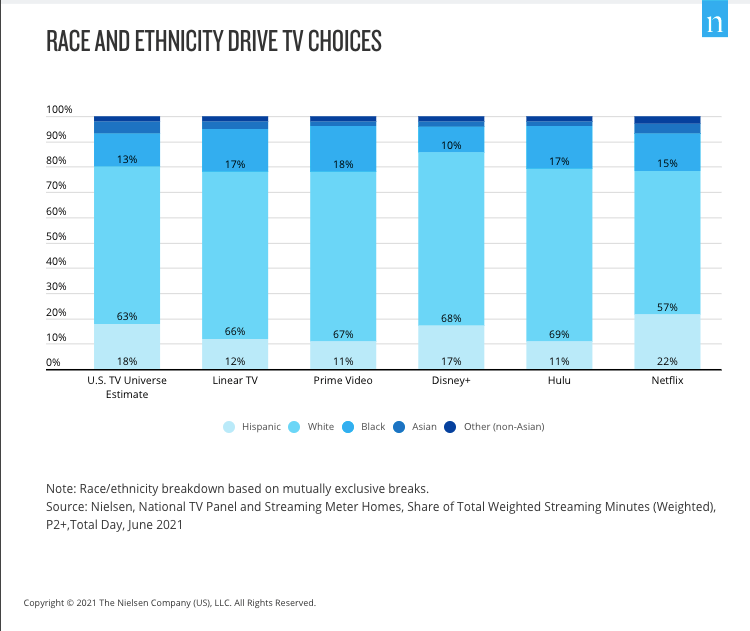
Nielsen comments, “Amid the sea of growing choice, content becomes a key differentiator, especially when publishers identify needs that are not being met.”
SVOD remains the biggest draw across the streaming space (51% of minutes viewed in June 2021), but ad-supported video-on-demand (AVOD), multichannel video programming distributors (MVPDs) and virtual MVPDs (vMVPDs) have grown to account for a combined 36% of viewing share.
“An array of publishers in these categories are attracting more diverse audiences than traditional TV and SVOD options are,” Nielsen says.
THE MULTICULTURAL STREAMING AUDIENCE
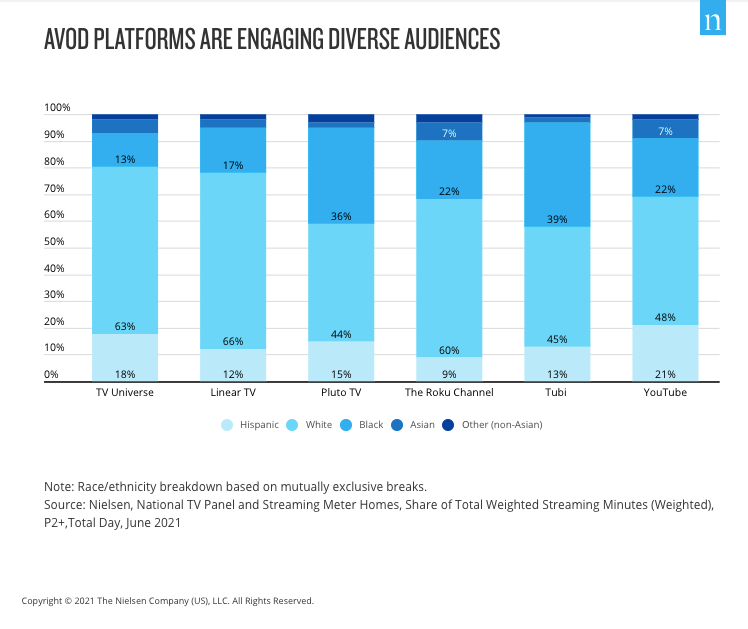
Black audiences accounted for 24% of all minutes viewed across all AVOD services in June, Nielsen finds.
Among AVOD platforms, Tubi, owned by Fox, attracts the largest share from Black audiences: they watched 39% of the minutes viewed from this platform in June, significantly more than the 17% of the minutes they watched on linear TV.
Pluto TV, owned by ViacomCBS, also attracts a sizable Black audience; Pluto TV accounted for 36% of the platform’s viewed minutes in June.
Hispanics account for 19% of the U.S. population, and that’s very close to their representation in the U.S. TV universe (18%). This community, however, spends notably less of its time with traditional TV than it does with streaming services, including newcomer AVOD platforms like Pluto TV and Tubi.
The real standout, however, is YouTube, which accounted for 21% of viewing minutes among Hispanics in June.
While race and ethnicity are areas where personalization can play a big role for a streaming video operation, Nielsen notes that teens represent another big growth channel.
Disney+ attracts the biggest share of minutes viewed among people 2-17. Persons 55 and older accounts for a notable share of time with Amazon Prime Video and several of the newer AVOD and MVPD/vMVPD entrants.
Is there a heightened level of concern for broadcast media leaders?
“Despite the growth of streaming, brands and media buyers should not abandon more traditional media options, especially when they are evolving,” Nielsen concludes, noting that linear streaming TV programming “has become a media mainstay” that kept the attention of TV viewers for three hours per day during the month of June 2021.
“No matter the platform, creating content that resonates with unique audiences, especially those that have been historically excluded from representation on TV, is a strategy that continues to win with viewers, advertisers and new entrants to the streaming wars.”