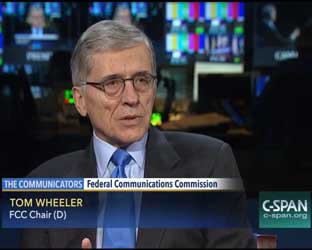
The FCC’s media cross-ownership rules, which were left intact on Wednesday following a Commission vote, prohibit the ownership of a daily newspaper and any full-power broadcast station that services the same community.
The rules were designed to limit media concentration in TV and radio.
The rules were passed when 93 KHJ in Los Angeles was the market’s leading source of contemporary hit music and music lovers were purchasing LPs and 8-Tracks of Elton John’s “Captain Fantastic & The Brown Dirt Cowboy.”
That’s why several leading media brokers RBR + TVBR spoke with are highly disappointed with the Commission’s decision to leave intact rules that were written at a time CB Radios were a hot fad.

“Why we have any restrictions on cross-ownership is beyond me,” says Fred Kalil, of Tucson-based Kalil & Co. “You have to evolve a little bit.”
For Kalil, amending the cross-ownership rules is as simple as looking at the advertising pie. “Different entities are controlling different pieces of the pie, but radio’s piece of the pie is so small. These restrictions need to be lifted, not strengthened.”
Dick Foreman, of Stamford, Conn.-based Richard A. Foreman Associates, believes the FCC “has done another great injustice” by prevent cross-marketing of the newspaper and radio industries.
“With newspapers trading at three times to four times cash flow and radio stations at north of six times cash flow, and the fact that with newspapers you’re dealing with an aging and eroding consumer base, the FCC could have possibly held back the degradation of the newspaper business,” Foreman says. “Changes to these rules should have happened 10 years ago.”
The fact that no changes were made doesn’t surprise Foreman. “This FCC has been onerous toward the basic marketplace that they regulate,” he says. “They have been very, very, regulatorily oppressive.”
San Francisco-based Elliot Evers, managing director of Media Venture Partners, also says it’s not the least bit remarkable that the Wheeler-led Commission failed to amend the media cross-ownership rules.
“It is a very disappointing turn of events,” Evers says. “But, given the political composition of our current commission, it is not surprising in the least.”
He believes that the lack of “pragmatic liberalization” of the rules is amazing, considering the plethora of choices consumers have today. “The rules are so antiquated it’s almost comical,” he says.
Yet, Evers believes newspaper owners are so financially stressed, they’d never have the appetite for a TV deal. At the same time, TV station owners would likely have no interest in investing in newspapers.
“Where liberalization of the rules would take place is not meaningful,” he argues. “What does matter is where the voices count and the ‘sub caps.’”
In fact, Evers sees nothing wrong with an owner owning up to 8 FMs in a market, instead of the current 5 FM/3 AM limitations.
Asked by RBR + TVBR about how that would play out in a market such as Miami, which has 19 full-market commercial FM signals, many of which serve Spanish-speaking listeners, Evers says, “The industry is competing against all media and all arenas, including Spotify and Pandora. We can’t just look at other FM broadcasters as competition.”
RBR + TVBR Observation: One company owning eight FMs in a market is certainly not going to sit well with some radio broadcasters, given the competitive balance the current restrictions provides … right? Then again, don’t translators that retransmit an AM station or an FM station’s HD signal already give companies the ability to go beyond these rules? Meanwhile, couldn’t the right radio or television company save a newspaper from dying by being allowed to own and/or operate it, waiver-free? The demise of the Tampa Tribune after 20+ years of decay is another reason why Mr. Wheeler’s decision to leave intact rules written when the Bee Gees’ “Jive Talkin’” dominated the Top 40 charts is highly questionable.
Mr. Wheeler, we await your comments on why you refuse to budge. No Jive Talkin’, please.